3 Best Autoresponder Follow Up in 2026 (Ranked and Compared)

By Kushal Magar · April 23, 2026 · 12 min read
Key Takeaway
This guide ranks the 3 best autoresponder follow up tools in 2026 across data quality, sending infrastructure, trigger sophistication, integration depth, and B2B fit. The platforms reviewed are HubSpot Sales Hub, Smartlead, and SyncGTM. HubSpot leads for CRM-integrated follow-up where every touch ties to a deal record — pricing starts on a free tier and climbs to $90 per user per month on Professional. Smartlead leads for pure cold email autoresponder follow up at high volume, with unlimited inboxes, automated warm-up, and reply handling from $39 per month. SyncGTM leads for B2B GTM teams that want autoresponder follow up triggered on real buying signals — funding, hiring, tech-stack shifts — wired into waterfall enrichment across 50-plus providers and native CRM sync, all from $99 per month flat with no per-seat tax. For inbound and CRM-heavy teams, HubSpot wins. For volume outbound and agencies, Smartlead wins. For signal-first B2B GTM teams that want follow-ups wired into pipeline, SyncGTM delivers the most complete workflow.
Autoresponder follow up broke in 2025. The old playbook — a seven-email drip over fourteen days, identical copy, same subject line swapping first-name tokens — now lands reply rates below 2% on most B2B lists. Gmail and Microsoft tightened bulk sender rules at the SMTP level, consumer-grade warm-up networks collapsed inbox reputation across thousands of domains, and buyers got tired of being drip-marketed on a timer that had nothing to do with their actual buying window.
This post ranks the 3 best autoresponder follow up tools for B2B GTM teams in 2026 — with real pricing, honest pros and cons, and a clear recommendation for each use case. We cut through the marketing fluff of fifteen-tool roundups that mash together creator newsletters and enterprise sales platforms, and focus on the three tools that actually move pipeline: HubSpot for CRM-integrated follow-up, Smartlead for volume cold email, and SyncGTM for signal-driven B2B GTM workflows.
Quick Summary
The best autoresponder follow up tool in 2026 depends on your motion and stack. HubSpot Sales Hub ($0–$90/user/mo) wins for CRM-integrated follow-up where every open, reply, and task syncs to the deal record. Smartlead ($39/mo) leads on cold email volume with unlimited inboxes, automated warm-up, and AI reply handling. SyncGTM ($99/mo Starter) embeds autoresponder follow up inside a full GTM platform with waterfall enrichment, AI agents, buying-signal triggers, and CRM sync — the most complete workflow for teams that want every follow-up tied to a real pipeline action.
TL;DR: Best Autoresponder Follow Up in 2026
- HubSpot Sales Hub — Best for CRM-integrated follow-up. Sequences, tasks, and replies sync to the deal record natively. Free tier available; Professional from $90/user/mo.
- Smartlead — Best for pure cold email autoresponder follow up. Unlimited inboxes, automated warm-up, AI reply handling, sub-sequences on engagement. From $39/mo.
- SyncGTM — Best for signal-triggered autoresponder follow up inside a full GTM stack. Waterfall enrichment, AI agents, buying-signal triggers, CRM sync. From $99/mo Starter (free tier available).
What Is Autoresponder Follow Up?
An autoresponder follow up is an automated email (or sequence of emails) sent to a prospect on a timer or a trigger — no human hitting send. The trigger can be a form fill, a download, a reply, an open, a site visit, a CRM stage change, or a buying signal pulled from enrichment data. Modern autoresponder follow up tools in 2026 chain these triggers into multi-step cadences with conditional branching: pause on reply, escalate on repeat open, re-enrich on bounce, hand off to AE on meeting book.
According to Validity's 2024 Email Deliverability Benchmark, roughly 15% of legitimate B2B email fails to reach the inbox globally — and that number climbs above 20% for cold outbound and unwarmed autoresponder streams. The tool you choose matters more than the copy you write. Bad infrastructure burns your domain reputation faster than any subject line can recover it.
The split that defines autoresponder follow up in 2026 is timer-based versus signal-based. Timer-based autoresponders send on day 1, day 3, day 7, day 14 — regardless of what the prospect is actually doing. Signal-based autoresponder follow up fires only when a real event happens: prospect visits the pricing page, company raises a Series B, a new VP of Sales gets hired, a competitor contract is up for renewal. Signal-based cadences see 3 to 4 times the reply rate of timer-based blasts, with a fraction of the volume.
One non-negotiable in 2026: if your autoresponder follow up is still firing on a seven-email timer from a single unwarmed domain, your reply rate is not the problem — your infrastructure and targeting are. Every tool below fixes that layer before copy ever gets tested. For more on why most follow-up sequences miss, see our guide on follow-up sales emails when prospects go silent.
How We Ranked These Autoresponder Follow Up Tools
We evaluated each platform across six dimensions that separate real B2B GTM infrastructure from generic marketing autoresponders. Creator-first platforms like Kit and Mailchimp were excluded — they optimize for newsletter broadcast, not sales follow-up on ICP-matched pipeline.
- Trigger sophistication: Does the autoresponder fire on timers only, or can it trigger on CRM stage, enrichment signal, site visit, job change, and funding rounds?
- Data quality: Does the tool ship verified B2B emails and enrichment, or do you bring your own? What is the bounce rate on sourced data?
- Sending infrastructure: Unlimited inboxes, automated warm-up, IP rotation, domain health monitoring, and bounce classification.
- Branching and conditional logic: Pause on reply, escalate on engagement, re-enrich on bounce, hand off to human on qualified response.
- Integration depth: Native CRM sync (HubSpot, Salesforce, Pipedrive, Attio), sequencer bridges, webhooks, and data warehouse exports.
- Pricing transparency: Flat-fee and predictable, or does real cost climb 2 to 4 times after seats, credits, and add-ons?
1. HubSpot Sales Hub — Best for CRM-Integrated Autoresponder Follow Up
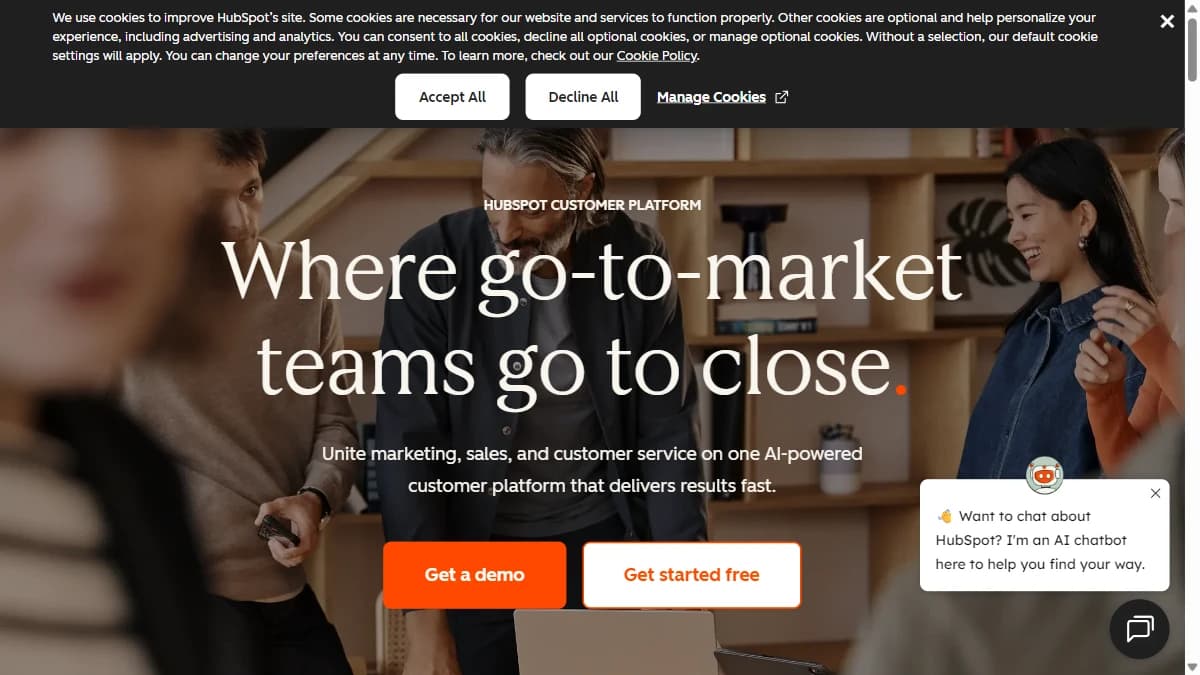
HubSpot Sales Hub — autoresponder follow up embedded inside the CRM, every touch tied to a deal
HubSpot Sales Hub is the default autoresponder follow up tool for B2B teams already running the HubSpot CRM. Sequences, tasks, and replies sync natively to the deal record — no Zapier, no webhook stitching, no lost context. For mid-market teams where sales and marketing live in the same platform, this consolidation is the main unlock.
The sequences engine handles multi-step cadences with conditional logic: send email one, wait three days, check for reply, fire LinkedIn task, wait two days, send email two. Replies auto-pause the sequence and notify the rep. Every engagement event — open, click, reply, meeting booked — lands on the contact timeline, which means the AE picking up the handoff has full context without digging through a separate sequencer.
Where HubSpot struggles: the free tier caps sequence enrollment and personalization tokens, and the real power sits behind the Professional tier at $90 per user per month (billed annually). Per-seat pricing compounds fast — a five-person SDR team clears $450 per month before any enrichment or data add-ons. Sending infrastructure is also CRM-first, not cold-email-first — no unlimited inbox model, no automated warm-up network, which means high-volume outbound campaigns need a bolt-on tool.
Pros
- ✓ Native CRM sync — every follow-up tied to the deal record
- ✓ Sequences with conditional logic and auto-pause on reply
- ✓ Task automation (calls, LinkedIn, custom steps)
- ✓ Free tier for small teams evaluating the platform
- ✓ Deep reporting on sequence performance by rep and deal stage
- ✓ Massive ecosystem of third-party integrations
Cons
- ✗ Per-seat pricing compounds fast across GTM teams
- ✗ Sending infra is CRM-first, no unlimited inbox model
- ✗ No native warm-up network — cold outbound needs a bolt-on
- ✗ Enrichment requires paid add-on (Breeze Intelligence)
- ✗ Professional tier gates most advanced trigger logic
Best for: Mid-market B2B teams already on HubSpot CRM, inbound-led sales motions, and RevOps leaders who want every autoresponder follow up touch to sync to the deal record natively.
Pricing: Free tier (limited sequences and templates). Starter from $20/user/mo. Professional from $90/user/mo (most advanced autoresponder follow up features sit here). Enterprise from $150/user/mo. Billed annually. See our full guide on personalized follow-up emails for sales for cadence best practices that work across any platform.
2. Smartlead — Best for Cold Email Autoresponder Follow Up at Volume
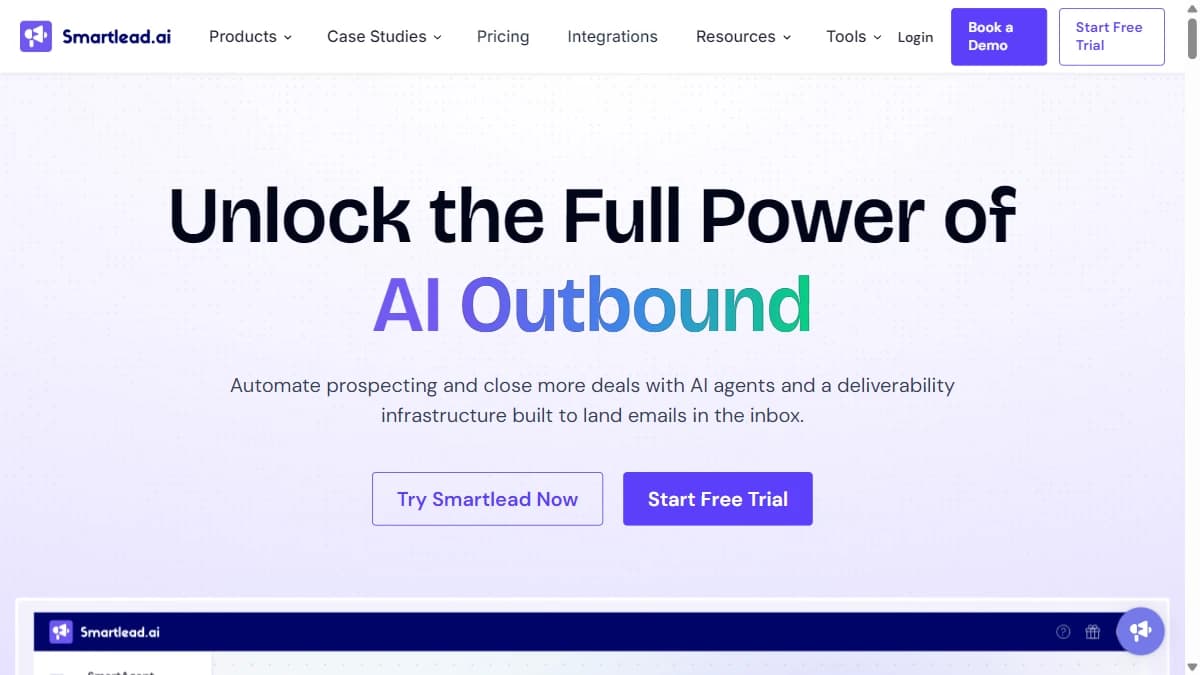
Smartlead — unlimited inboxes, automated warm-up, and AI reply handling for cold email follow-up
Smartlead is the autoresponder follow up tool of choice for agencies, lead-gen shops, and outbound-heavy B2B teams that measure success in sends per day and meetings per month. The unlock is the unlimited inbox model — connect as many Google Workspace, Outlook, or custom SMTP mailboxes as you want on a flat fee, with automated warm-up and IP rotation handled in the background.
On the follow-up side, Smartlead runs behavior-based sub-sequences. When a prospect opens but does not reply, the tool can branch into a different follow-up track. When a prospect replies, an AI reply handler classifies the response — interested, out-of-office, wrong person, unsubscribe — and either pauses the sequence, auto-forwards to the right rep, or triggers a sub-sequence for objection handling. That layer alone eliminates hours of manual triage per week for high-volume teams.
Where Smartlead struggles: the 450 million-lead finder data quality is mid-tier compared to dedicated waterfall providers, and native CRM sync is limited to webhooks or Zapier. Enterprise GTM teams bolt Smartlead onto a real data stack (SyncGTM or similar) for enrichment and onto HubSpot or Salesforce for pipeline management. Smartlead is best understood as the sending engine, not the full GTM workflow.
Pros
- ✓ Unlimited sending inboxes on every paid plan
- ✓ Automated warm-up network with reputation monitoring
- ✓ AI reply handler classifies and routes responses
- ✓ Behavior-based sub-sequences on open and engagement
- ✓ Flat-fee pricing scales cleanly with volume
- ✓ API-first — strong webhook and programmatic control
Cons
- ✗ Lead finder data quality lags dedicated waterfall providers
- ✗ No native CRM sync — webhooks or Zapier only
- ✗ No signal-based triggers (funding, job change, tech-stack)
- ✗ Enrichment needs a separate bolt-on tool
- ✗ Focused on cold outbound — weaker for inbound lifecycle
Best for: Lead-gen agencies, SDR shops, and outbound-heavy B2B teams running autoresponder follow up at scale who prioritize sending volume and inbox rotation over built-in CRM integration.
Pricing: Basic from $39/month (2,000 active leads, unlimited email accounts). Pro from $94/month. Custom enterprise pricing at higher volume. 14-day free trial. For deeper infrastructure context, see our guide on email domain warmup — the layer that decides whether your autoresponder actually lands in the inbox.
3. SyncGTM — Best for Signal-Triggered Autoresponder Follow Up Inside a Full GTM Stack
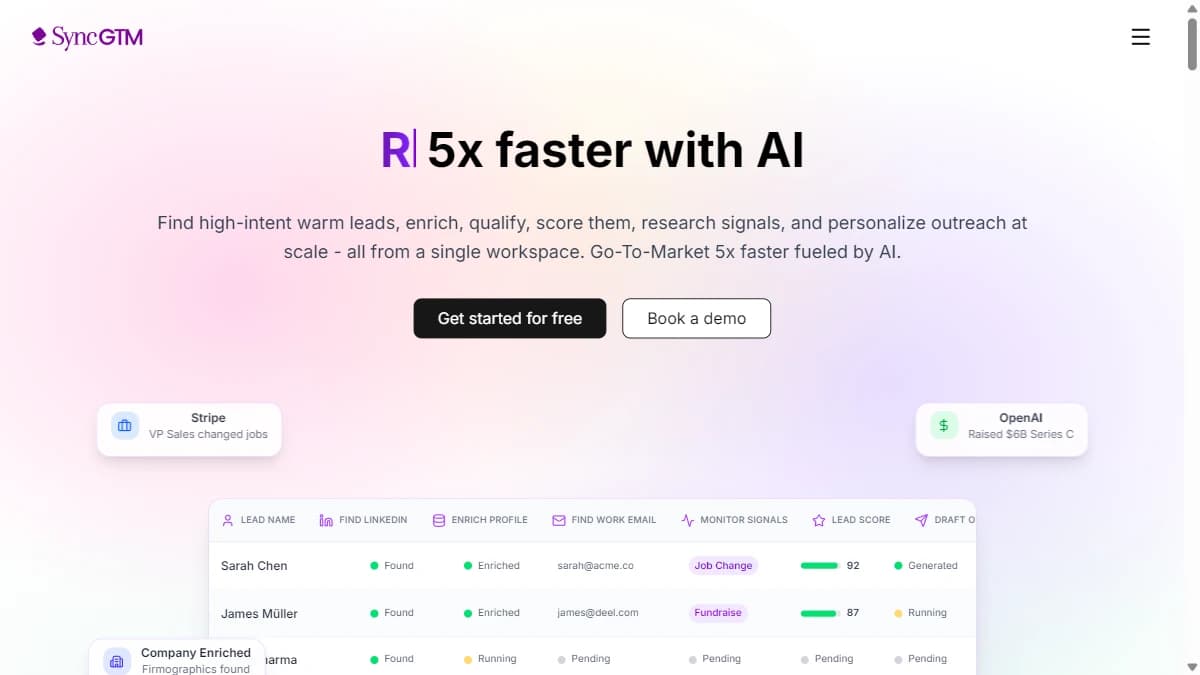
SyncGTM — autoresponder follow up wired to buying signals, waterfall enrichment, AI agents, and CRM
SyncGTM takes a different angle from both CRM-first platforms and volume-first cold email tools: instead of treating autoresponder follow up as a timer-based cadence, SyncGTM fires every follow-up on a real buying signal. New VP of Sales gets hired at a target account — cadence fires. Company raises a Series B — cadence fires. Prospect visits the pricing page — cadence fires. Timer-based drips still work, but the signal layer on top is what separates SyncGTM from every tool in the roundup.
Every autoresponder follow up runs on verified data from waterfall enrichment across 50-plus providers, every bounce routes back through re-enrichment to find an alternate address, and every reply syncs to HubSpot, Salesforce, Pipedrive, or Attio natively. AI agents draft opening lines from LinkedIn, company, and funding data — not first-name token swaps. The bounce classifier auto-retries sends via alternate addresses, which closes the loop most sending tools leave open.
What makes SyncGTM the strongest B2B GTM choice is the flat-fee pricing and free tier. No per-seat tax means a ten-person SDR team costs the same as a solo founder — unlike HubSpot Professional, which would clear $900 per month for the same headcount. And the free tier includes AI agents and CRM sync, so teams can validate signal-triggered autoresponder follow up on a real pipeline before committing budget. Explore pre-built workflow templates or take a product tour.
Pros
- ✓ Signal-triggered autoresponder follow up (funding, hiring, tech-stack)
- ✓ Waterfall enrichment across 50+ providers on every paid plan
- ✓ Bounce classifier auto-retries sends via alternate addresses
- ✓ AI agents draft openers from LinkedIn, company, and signal data
- ✓ Native CRM sync (HubSpot, Salesforce, Pipedrive, Attio)
- ✓ No per-seat pricing — team growth never compounds costs
- ✓ Free tier with AI agents and CRM integration
Cons
- ✗ Best value comes from using the full GTM stack, not autoresponder alone
- ✗ Lower raw sending ceiling than Smartlead for pure blast volume
- ✗ Newer platform; reference-customer base still growing vs. HubSpot
Best for: B2B GTM teams, RevOps leaders, and founders who want autoresponder follow up wired directly into waterfall enrichment, buying signals, AI agents, and CRM — without stitching together a separate data vendor, sequencer, and deliverability tool.
Pricing: Free tier available with AI agents and CRM integration. Starter $99/mo with waterfall enrichment, verified emails, signal triggers, and deliverability monitoring. Pro and Business tiers for higher volume.
Side-by-Side Comparison
| Tool | Best For | Trigger Model | CRM Sync | Free Tier | Starting Price |
|---|---|---|---|---|---|
| HubSpot Sales Hub | CRM-integrated follow-up | Timer + CRM stage | Native (HubSpot CRM) | Yes (limited) | $20/user/mo |
| Smartlead | Cold email at volume | Timer + engagement | Webhooks / Zapier | 14-day trial | $39/mo |
| SyncGTM | Signal-driven B2B GTM | Signal + timer + CRM + enrichment | Native (HubSpot, SF, Pipedrive, Attio) | Yes (AI agents + CRM) | $99/mo Starter |
How to Choose the Right Autoresponder Follow Up Tool
The right autoresponder follow up tool depends on four factors: where your contact data lives, how many emails you send per month, what your team structure looks like (seats, agency vs. in-house), and how tightly your follow-ups need to wire into CRM and pipeline signals. Here is the decision framework.
- If every follow-up must sync to the CRM deal record →HubSpot Sales Hub is the default — especially if marketing already lives on the same platform. Budget for Professional ($90/user/mo) to unlock full sequence logic.
- If you send 50,000+ cold emails per month across many inboxes →Smartlead ships unlimited inboxes, automated warm-up, and AI reply handling. Flat fee scales cleanly past ten mailboxes.
- If autoresponder follow up must trigger on buying signals →SyncGTM embeds signal triggers, waterfall enrichment, AI openers, and bounce retry inside one platform. Every send fires on a real pipeline event.
- If budget is the constraint →Start on SyncGTM's free tier with AI agents and CRM integration, then upgrade to Starter at $99/mo once your autoresponder follow up volume justifies waterfall enrichment.
For broader cadence strategy, see our guide on how many touch points before a sale — it covers the benchmark cadence length and channel mix that works across any autoresponder follow up tool.
Final Verdict
Most B2B teams do not miss pipeline because their autoresponder follow up copy is bad. They miss pipeline because their cadences fire on timers instead of signals, their sending domain is cooked, and their follow-ups have no retry logic on bounces. Autoresponder follow up in 2026 is an infrastructure and targeting problem, not a creative one — and the tool you pick decides whether you spend Monday fixing deliverability or Monday on a discovery call.
For CRM-integrated follow-up where every touch syncs to the deal record, HubSpot Sales Hub is still the default for mid-market B2B teams. For pure cold email volume and agency workflows, Smartlead wins on inbox rotation, automated warm-up, and AI reply handling at a flat fee.
For B2B GTM teams that want autoresponder follow up wired into waterfall enrichment, buying signals, AI agents, and CRM sync — so every send fires on a real pipeline action instead of a timer — SyncGTM is the most complete workflow. Start with the tool that matches today's stack, and consolidate into a full GTM platform as autoresponder follow up scales into pipeline.
Want deeper context? See our guides on follow-up sales emails when prospects do not respond, follow-up email after an in-person sales call, and email domain warmup.
This post was last reviewed in April 2026. Pricing and features are subject to change — verify current plans on each vendor's website before purchasing.