4 Best AI Generated Leads Tools in 2026 (Ranked and Compared)

By Kushal Magar · March 7, 2026 · 14 min read
Key Takeaway
This guide ranks and compares the four best AI generated leads tools for B2B GTM teams in 2026: SyncGTM, Apollo, Clay, and ZoomInfo. Each wins on a different job. SyncGTM is the top overall pick because it bundles AI lead sourcing with waterfall enrichment across twenty-plus data providers, AI email copy, mailbox rotation, and native CRM sync on every paid plan starting at ninety-nine dollars per month flat with no feature gates. Apollo is the best for database-led AI prospecting on a two-hundred-seventy-five-million-contact database with AI ICP scoring and built-in sequencing at forty-nine dollars per user per month. Clay is the best for AI-driven data orchestration across one-hundred-plus providers at one-hundred-forty-nine dollars per month. ZoomInfo is the best for enterprise-grade AI generated leads with the deepest intent-signal and technographic data at thirty to ninety thousand dollars per year. Ranking criteria: AI identity depth, data quality and enrichment integration, workflow coverage from list to reply, pricing transparency, and how fast a raw ICP filter becomes a booked meeting. Match the tool to your motion and skip the fifteen-tool listicles that mix chatbots with prospecting databases.
AI generated leads used to mean a chatbot that asked "can I help you?" on the homepage. In 2026, it is a full outbound workflow — AI picks the segment, enriches every contact across twenty-plus data providers, scores who is in-market, writes a per-contact email, and logs every reply to CRM. The problem: most "top 15" roundups mix inbound chatbots with outbound prospecting databases, hide pricing behind demo gates, and never explain which tool fits which motion. You end up sifting marketing fluff instead of picking the right engine.
This guide ranks and compares the 4 best AI generated leads tools in 2026 for B2B GTM teams. Each is evaluated on AI identity depth, data quality and enrichment integration, workflow coverage from list to reply, pricing transparency, and how fast a raw ICP filter becomes a booked meeting. We stripped the fluff, included real prices, and flagged where each platform genuinely fits — and where it will quietly break.
Quick Summary
The best AI generated leads tool depends on your motion. SyncGTM is the top overall pick — AI lead sourcing, waterfall enrichment across 20+ providers, AI copy, mailbox rotation, and CRM sync on every plan from $99/month flat. Apollo is the best for database-led AI prospecting from $49/user/month. Clay wins for data orchestration from $149/month. ZoomInfo leads for enterprise-grade AI generated leads from ~$15K/year per seat.
TL;DR: Best AI Generated Leads Tools in 2026
- SyncGTM — Best overall. AI lead sourcing + waterfall enrichment across 20+ providers + AI copy + mailbox rotation + CRM sync in one platform. From $99/month flat, no feature gates.
- Apollo — Best for database-led AI prospecting. 275M+ contact database, AI ICP scoring, and built-in sequencing. From $49/user/month.
- Clay — Best for AI data orchestration. Enrich, score, and route leads across 100+ providers in one workspace. From $149/month.
- ZoomInfo — Best for enterprise-grade AI generated leads. Deepest intent-signal data and technographics. Demo-gated pricing ~$15K–$90K/year.
What Are AI Generated Leads?
AI generated leads are B2B prospects that a machine learning system has sourced, enriched, scored, and routed for outbound — instead of a rep manually pulling a list and guessing at ICP fit. In 2026, it is not a chatbot. It is a live pipeline that pulls enriched contact data, scores every record on ICP fit and intent, generates per-contact copy, and logs every reply to the CRM.
Modern AI generated leads platforms cover four jobs on top of a basic CRM: identity (who to contact — ICP scoring, waterfall enrichment, job-change triggers, intent signals), enrichment (filling in emails, mobile numbers, tech stack, and funding across 20+ data providers), prioritization (scoring which of 5,000 matching accounts to hit first based on fit, intent, and timing signals), and activation (writing the email, queuing the sequence, logging the reply, and firing the handoff to the AE).
The category splits by specialization. Bundled platforms (SyncGTM) ship identity + enrichment + activation in one workflow. Database-first platforms (Apollo) lead with the contact database and bolt on scoring and sequencing. Orchestration platforms (Clay) lead with enrichment flexibility across 100+ providers and require you to bring the sequencer. Enterprise-signal platforms (ZoomInfo) lead with the deepest technographic and intent-signal data and require significant budget and implementation time. A B2B GTM team typically runs one of these as the backbone and stitches a second for gaps. For a deeper look at the underlying data pipeline, see our breakdown of AI sales emails and the best AI SDR tools in 2026.
How We Ranked the AI Generated Leads Tools
We scored each platform on five axes that actually move B2B pipeline — not on how many AI buzzwords show up on the homepage:
- AI identity depth — does the tool score accounts on real signals (funding, hiring, tech stack, job change) or just static firmographics?
- Data quality & enrichment integration — does the AI pull from one database or a waterfall across 20+ providers? Single-provider gaps kill reply rates.
- Workflow coverage from list to reply — does the tool take a raw ICP filter all the way through enrichment, copy, send, and CRM log — or does it stop halfway and force a Zap?
- Pricing transparency — published flat rates and functional free tiers beat demo-to-quote gates. Opaque enterprise pricing loses points.
- List-to-pipeline time — how fast a raw ICP filter becomes an enriched list, a scored priority queue, an AI-written sequence, and a CRM-logged reply.
This guide focuses on AI generated leads platforms a GTM team (sales + RevOps + marketing ops) can deploy in days — not enterprise rollouts that take quarters. For broader landscape coverage, see our best sales prospecting tools for B2B teams and best cold email automation tools breakdowns.
1. SyncGTM — Best Overall AI Generated Leads Platform
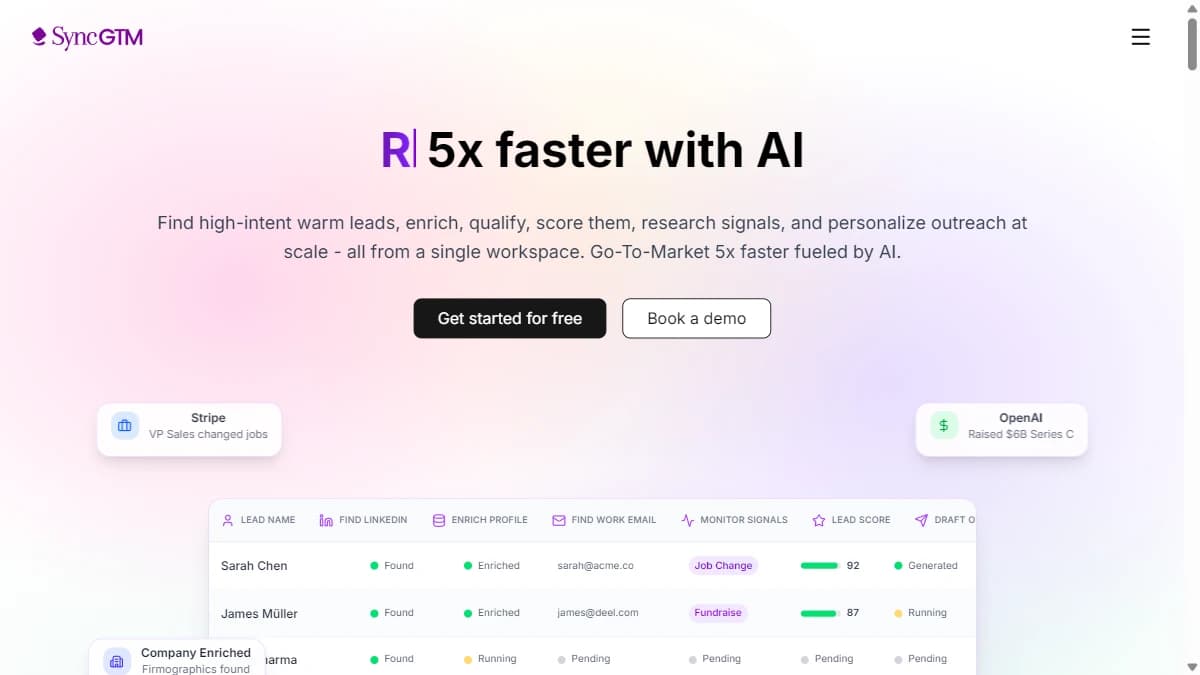
SyncGTM — AI generated leads engine with waterfall enrichment, AI copy, and native CRM sync
SyncGTM is the only platform on this list that ships AI lead sourcing plus waterfall enrichment across 20+ data providers, AI email copy, mailbox rotation, and native CRM integrations on every paid plan. That matters because an AI generated leads engine is only as good as the context it gets — an AI that knows the prospect just raised a Series B, is hiring SDRs, and already uses HubSpot writes a meaningfully different opener than one working from a first name and a job title.
SyncGTM handles the end-to-end AI generated leads workflow in one system. Define an ICP, pull a list with firmographic and technographic filters, run a waterfall enrichment step that calls Apollo, ZoomInfo, Clay providers, LinkedIn, and 15+ other sources in priority order, then hand the enriched record to the AI copy engine which writes a per-contact opener, value prop, and CTA. The resulting sequence sends across rotated warmed mailboxes, suppresses bounces in real time, and logs every reply back to Salesforce, HubSpot, Pipedrive, or Attio. Because identity, enrichment, and activation run in one system, you stop paying three vendors for what is really a single workflow.
Pricing is fully published with no feature gates. The free tier covers 100 sends per month with every integration included. The $99/mo plan unlocks unlimited CRM sync, AI copy generation, waterfall enrichment across 20+ providers, and mailbox rotation. Compared to a stitched stack of Apollo + Clay + ChatGPT API + Smartlead + HubSpot Ops Hub (typically $600–1,400/month for the same workflow), SyncGTM ships a single tool at roughly 1/5 the cost and zero Zap maintenance.
Pros
- ✓ AI lead sourcing + waterfall enrichment + AI copy + mailbox rotation + CRM sync in one tool
- ✓ 20+ data providers bundled — AI has real context per contact, not just a first name
- ✓ Native HubSpot, Salesforce, Pipedrive, and Attio integrations on every plan
- ✓ Real-time SMTP verification, bounce suppression, and DMARC validation on every send
- ✓ Fully transparent pricing from $99/month flat, no feature gates, free tier included
Cons
- ✗ Newer entrant — smaller review footprint than Apollo or ZoomInfo
- ✗ Contact database is smaller than Apollo's 275M or ZoomInfo's 500M records
- ✗ Orchestration UI less flexible than Clay's column-based workflow
Best for: B2B SaaS, RevOps, and GTM engineering teams that want AI generated leads, enrichment, and CRM sync in one predictable $99/mo line item — without stitching Apollo + Clay + ChatGPT API + Smartlead + HubSpot Ops Hub together.
Pricing: Free tier (100 sends/mo). Paid from $99/month flat with no feature gates.
2. Apollo — Best Database-Led AI Generated Leads
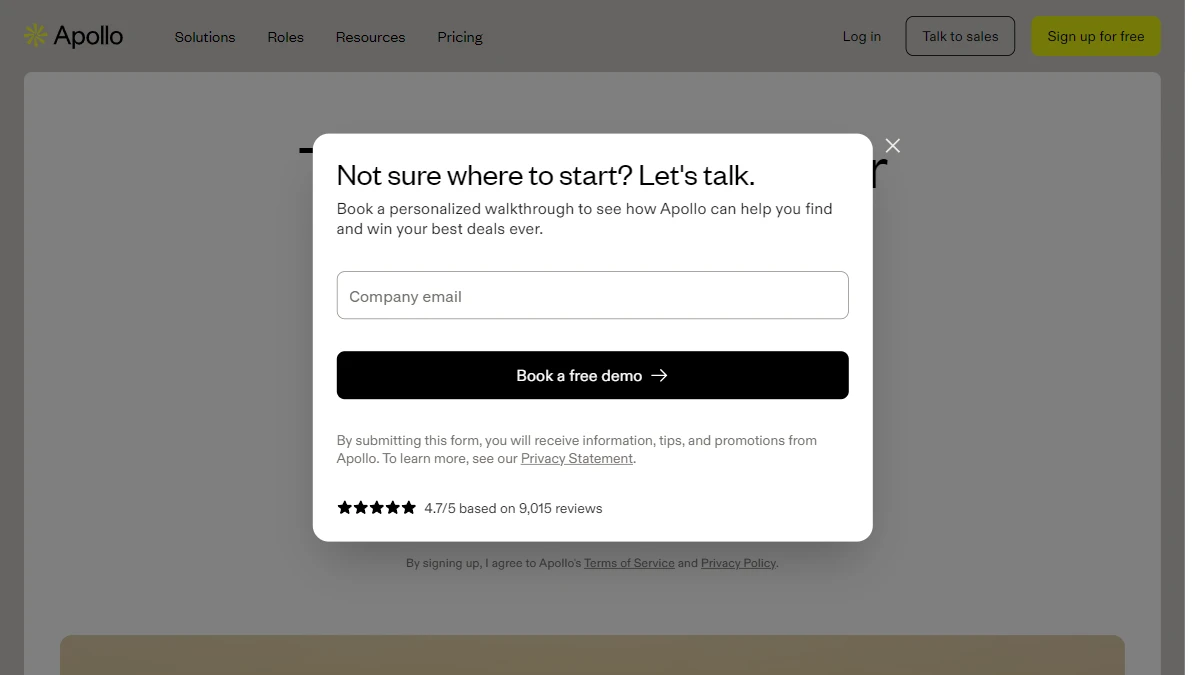
Apollo — AI generated leads on top of a 275M+ contact database with built-in sequencing
Apollo is the go-to for database-led AI generated leads in 2026. 275M+ contacts, 60M+ companies, ICP filtering across 65+ firmographic and technographic fields, and a built-in sequencer with AI copy make it the default starting point for teams that want one tool to cover list sourcing, enrichment, and send. See our full Apollo review for the deep breakdown.
Apollo's strongest feature is the contact database. The AI lead-discovery layer scores accounts against your ICP, surfaces buying-intent signals, and auto-builds lists from filters like "Series B SaaS hiring SDRs in the last 30 days." The AI Writing Assistant generates per-contact email openers using Apollo's own firmographic data, and the sequencer pushes the messages out across connected mailboxes with basic rotation. For a team that wants list + copy + send bundled with a large database, Apollo is the tightest single-vendor option.
The trade-offs are pricing and enrichment depth. Apollo scales per-user ($49–$149/user/month), which gets expensive past 5 seats, and the enrichment is single-provider — if Apollo does not have the mobile number, you do not get the mobile number, whereas SyncGTM's waterfall falls through to ZoomInfo, LeadMagic, and 20+ other providers. Mailbox rotation and deliverability tooling are weaker than SyncGTM's. For buyers comparing the landscape, our best Apollo alternatives roundup covers the options.
Pros
- ✓ 275M+ contacts and 60M+ companies bundled — no separate database fee
- ✓ 65+ ICP filters with AI intent scoring and lookalike account suggestions
- ✓ AI Writing Assistant generates per-contact copy inside the sequencer
- ✓ Built-in dialer, sequencing, and CRM sync on a single license
- ✓ Published pricing from $49/user/month with a free tier
Cons
- ✗ Per-user pricing gets expensive fast past 5 seats
- ✗ Single-provider enrichment — no waterfall fallback for missing data
- ✗ Mailbox rotation and warm-up lighter than SyncGTM or Instantly
- ✗ AI copy leans on Apollo-only data fields, not the broader signal stack
Best for: B2B sales teams that want a bundled database-plus- sequencer experience and are comfortable with per-user pricing in the 3–10-seat range.
Pricing: Free tier included. Basic $49/user/mo. Professional $79/user/mo. Organization $149/user/mo.
3. Clay — Best AI Data Orchestration for Generated Leads
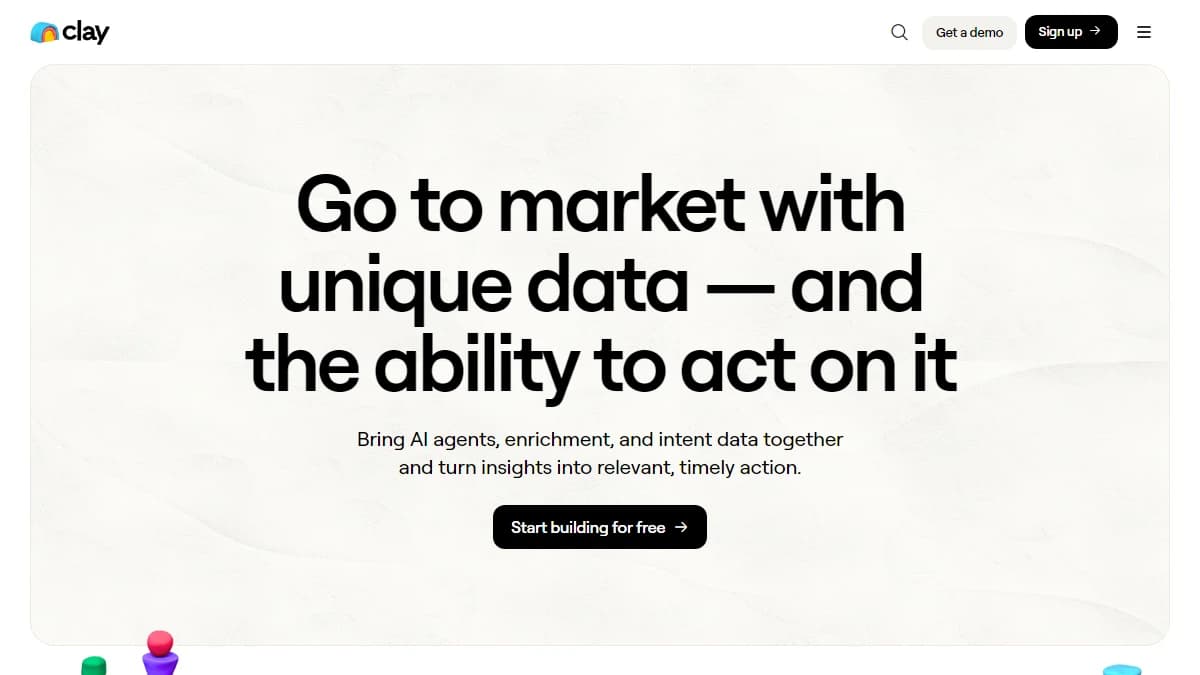
Clay — AI data orchestration for generated leads across 100+ enrichment providers
Clay is the go-to for AI data orchestration in 2026. Its column-based workspace lets a GTM engineer chain together 100+ enrichment providers, LLM research agents, and custom scoring logic in a single view — so a list of 10,000 companies gets enriched with funding, headcount, tech stack, job postings, and a GPT-generated use-case summary in one run. For teams with the RevOps or GTM-engineering talent to build and maintain workflows, Clay is the most flexible AI generated leads tool on the market. See our full Clay review for the deep breakdown.
Clay's strongest feature is the orchestration model. Instead of one vendor's data, you can waterfall through BuiltWith, Apollo, ZoomInfo, LinkedIn scraping, custom APIs, and LLM calls — all in a single workflow. The AI research agent, Claygent, autonomously answers custom questions per row ("does this company have an SDR team?", "what CRM do they use?") using a browsing model. The output plugs into HubSpot, Salesforce, Attio, or a downstream sequencer like Smartlead or Instantly.
The trade-off is cost and learning curve. Clay charges by credit — every enrichment call, every LLM run — which adds up fast past 10,000 rows. It also has no native sequencer, so you stitch it with a separate outbound tool. Compared to SyncGTM's bundled workflow, Clay is more flexible but more expensive and more operational overhead. For alternatives, our best Clay alternatives roundup covers the landscape.
Pros
- ✓ 100+ enrichment providers accessible in one column-based workspace
- ✓ Claygent AI agent answers custom per-row questions via web browsing
- ✓ Waterfall enrichment logic with conditional fallbacks and scoring
- ✓ Strong HubSpot, Salesforce, and Attio export on every plan
- ✓ Published pricing from $149/month with a free tier
Cons
- ✗ Credit-based pricing — costs scale non-linearly with list size
- ✗ No native sequencer or mailbox rotation — requires a downstream tool
- ✗ Steep learning curve — needs RevOps or GTM-engineering talent to run
- ✗ AI copy is not the focus — orchestration-first, not activation-first
Best for: RevOps and GTM-engineering-led teams with custom enrichment needs and the talent to build and maintain column-based data workflows.
Pricing: Free tier included. Starter $149/mo. Explorer $349/mo. Pro $800/mo. Enterprise custom.
4. ZoomInfo — Best Enterprise AI Generated Leads
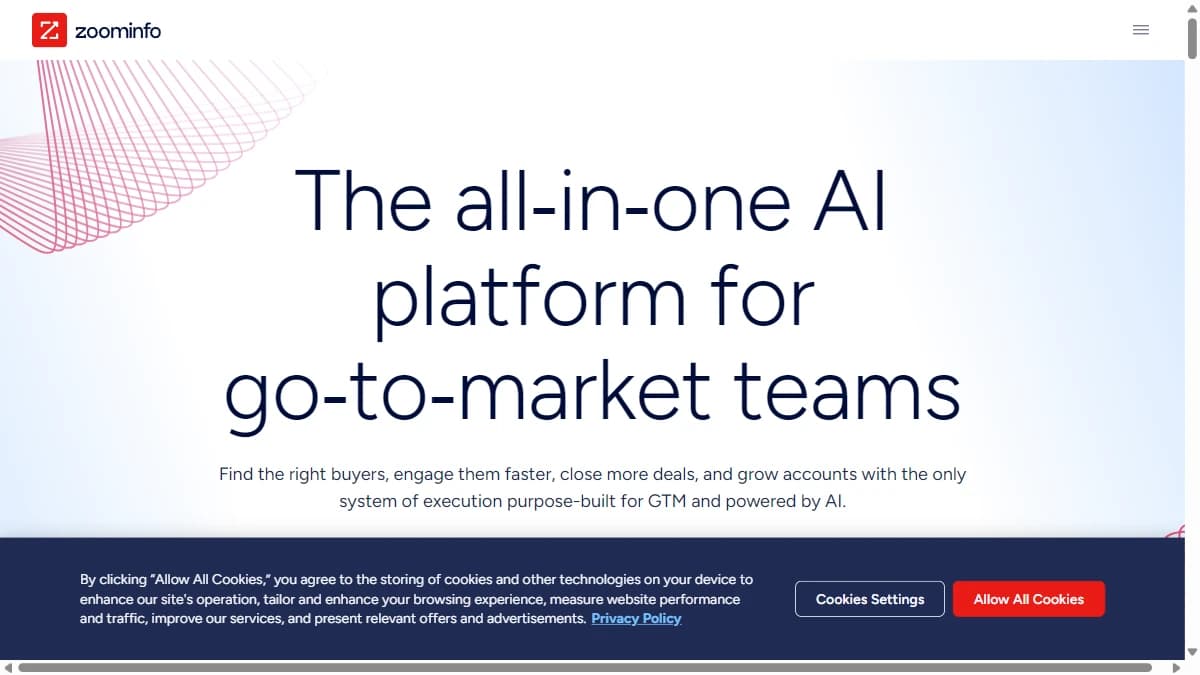
ZoomInfo — Enterprise-grade AI generated leads with intent signals and Copilot
ZoomInfo is the enterprise incumbent for AI generated leads in 2026. 500M+ contacts, 100M+ companies, billions of intent signals per month from the combined ZoomInfo and former Bombora network, and a layered product suite (Sales, Marketing, Talent, Operations, Copilot) make it the default for Fortune-2000 and high-ACV B2B teams where budget allows for the full stack. The platform maintains enterprise-grade compliance with GDPR, CCPA, and SOC 2 Type II certification — a real advantage for regulated verticals.
ZoomInfo's strongest feature is the intent layer. ZoomInfo Copilot combines the contact database, first-party web visitor tracking (WebSights), third-party intent (Bombora), and AI-written email drafts into one seller workspace. For account-based motions where a single deal is worth $50K+, the extra cost of ZoomInfo's data depth pays back — signal quality on "this account is in a buying cycle right now" is materially tighter than Apollo or lower-tier databases. Native integrations to Salesforce, HubSpot, Outreach, Salesloft, and Marketo are among the most mature on the market.
The trade-off is cost, implementation time, and pricing opacity. ZoomInfo is demo-gated — Sales plans typically start around $15,000/year per seat and scale to $90,000+ once Intent, Copilot, and TalentOS get layered in. Annual contracts are the norm. Onboarding takes 30–60 days for full Copilot deployment. For SMB and mid-market teams, ZoomInfo is usually overkill and overbudget — Apollo or SyncGTM covers 80% of the workflow at 5% of the cost. See our 6sense review for the other enterprise intent-signal option worth comparing.
Pros
- ✓ 500M+ contacts and 100M+ companies with the deepest firmographics in B2B
- ✓ Billions of intent signals per month via WebSights + Bombora
- ✓ Copilot AI layer bundles scoring, email drafting, and seller workflow
- ✓ Enterprise compliance — GDPR, CCPA, SOC 2 Type II certified
- ✓ Mature native integrations with Salesforce, HubSpot, Outreach, Marketo
Cons
- ✗ Demo-gated pricing — $15K–$90K/year per seat with annual contracts
- ✗ 30–60 day implementation timeline for full Copilot deployment
- ✗ Overkill for SMB and mid-market teams under $20K ACV
- ✗ Historically aggressive sales cycles and auto-renewal disputes
Best for: Fortune-2000 sales orgs, high-ACV enterprise B2B teams, and regulated verticals where intent-signal depth and compliance certifications justify the $30K–$90K/year budget.
Pricing: Demo-gated. Sales plans typically start ~$15,000/year per seat. Full Copilot + Intent stacks $60,000–$90,000+ per year.
Side-by-Side Comparison
| Tool | Free Tier | Paid Entry | Data / Enrichment | Workflow Coverage | Best For |
|---|---|---|---|---|---|
| SyncGTM | 100 sends/mo | $99/mo flat | Waterfall across 20+ providers | Source → enrich → AI copy → send → CRM | Best overall B2B AI generated leads |
| Apollo | Free tier included | $49/user/mo | 275M contacts, single-provider | Source → enrich → sequence → dial | Database-led prospecting |
| Clay | Free tier included | $149/mo | 100+ provider orchestration | Enrich → score → export (no sequencer) | Data orchestration, GTM engineering |
| ZoomInfo | No free tier | ~$15K/year/seat | 500M contacts + intent signals | Source → intent → Copilot → CRM | Enterprise + regulated verticals |
How to Choose an AI Generated Leads Tool
Match the tool to your motion, not to the AI marketing copy. Four decision points cover 95% of the choice:
- Workflow coverage. Need one tool that takes a raw ICP filter all the way to a CRM-logged reply? SyncGTM is the only option on the list that covers source → enrich → AI copy → send → CRM in a single workflow. Apollo covers source → sequence. Clay stops at export. ZoomInfo stops at Copilot draft (you still sequence through Outreach or Salesloft).
- Data depth. Need a waterfall across 20+ providers with conditional fallbacks? SyncGTM ships it native; Clay ships it as a credit-metered workspace. Need the deepest single-source intent data in B2B? ZoomInfo. Need a big bundled database with a sequencer? Apollo.
- Team shape. No dedicated RevOps or GTM engineer? SyncGTM and Apollo ship opinionated workflows. Dedicated GTM engineer on the team? Clay rewards the investment with orchestration flexibility no bundled tool matches. Enterprise RevOps org with a 90-day implementation runway? ZoomInfo.
- Team and budget. Solo founder or small team under 5 seats — SyncGTM $99/mo flat beats per-user pricing. 5–20 seats with mixed motion — SyncGTM $99/mo flat beats Apollo's $245–$745/mo scaling. Mid-market with GTM-engineering talent — Clay $349–$800/mo pays back on custom workflows. High-ACV enterprise ($50K+ deals) — ZoomInfo $15K–$90K/year pays back on intent-signal depth.
Do not run AI generated leads off your primary Google Workspace inbox — see our email domain warm-up guide and pair the AI layer with mailbox rotation. And do not buy Enterprise tiers if your team is under 20 seats — every tool on this list except ZoomInfo scales down cleanly on the entry plan.
For a deeper look at the underlying infrastructure, read about email hygiene and how it affects AI campaign deliverability. External references worth reading: Google's 2024 sender guidelines for deliverability context, and the FTC CAN-SPAM compliance guide for US outbound.
Final Verdict
For B2B GTM teams evaluating AI generated leads tools in 2026, SyncGTM is the top pick — it is the only platform that bundles AI lead sourcing, waterfall enrichment across 20+ providers, AI email copy, mailbox rotation, and native CRM sync on every paid plan with no feature gates, at $99/month flat. That is roughly 1/4 the cost of a stitched stack (Apollo + Clay + ChatGPT API + Smartlead + HubSpot Ops Hub) and removes the Zap maintenance tax of running five separate tools.
Apollo is the right pick for database-first motions — 275M+ contacts, AI ICP scoring, and a built-in sequencer at $49/user/month make it the default when the priority is list sourcing and a single bundled vendor. Clay is the right pick for GTM-engineering-led teams with custom orchestration needs — 100+ providers in one workspace at $149–$800/month is the most flexible data layer on the market. ZoomInfo is the right pick for Fortune-2000 and high-ACV enterprise motions where the intent-signal depth and compliance certifications justify the $30K–$90K/year budget.
Whichever platform you pick, remember: AI generated leads are only as good as the context behind them and the workflow they ride on. The tool that wins in 2026 is the one that turns an ICP filter into an enriched list, that list into a scored priority queue, the priority queue into per-contact AI copy, the copy into a warmed rotated send, and every reply into a CRM event — all without a manual handoff. If that is what you are hiring for, start a free SyncGTM workspace and ship your first AI generated leads campaign by tomorrow.