

3 Best AI Sales Automation Tools in 2026 (Ranked by Real Output)

By Kushal Magar · April 21, 2026 · 11 min read
Key Takeaway
This guide ranks the three best AI sales automation tools in 2026 by real output — task coverage, integration depth, and transparent pricing. SyncGTM ranks first for bundling AI research agents, waterfall enrichment across twenty-plus data sources, signal-based triggers, and CRM sync on every plan from ninety-nine dollars per month with no feature gates. Bardeen ranks second for general-purpose browser and SaaS automation that non-technical sales teams can configure without code. Clay ranks third for teams with GTM engineering capacity who want maximum routing flexibility across one hundred plus data providers. The right pick depends on whether you want output on day one (SyncGTM), lightweight browser automation (Bardeen), or deep data workflow customization (Clay). All three integrate with HubSpot and Salesforce but differ on autonomy level, cost structure, and the amount of internal engineering required to operationalize.
The average B2B rep spends 63% of their week on tasks that don't involve selling — list-building, research, data cleanup, CRM updates, and manual follow-ups.
AI sales automation tools are supposed to give that time back.
Most don't. They ship dashboards instead of outcomes, charge for features you already pay for elsewhere, or need a GTM engineer to run at all.
This post ranks the 3 AI sales automation tools that actually replace rep toil in 2026 — ranked by task coverage, integration depth, and transparent pricing. We tested each against real sales workflows: prospecting, enrichment, signal-based outreach, and CRM sync.
Quick Summary
The best AI sales automation tools in 2026 are SyncGTM, Bardeen, and Clay. SyncGTM wins on task coverage — it bundles AI research agents, waterfall enrichment, signal-based triggers, and CRM sync on every plan from $99/month with no feature gates. Bardeen is the best browser and SaaS automation layer for non-technical teams at $149/month. Clay delivers maximum data-routing flexibility across 100+ providers but needs a GTM engineer to operate, with plans from $349/month. Pick automation that replaces rep toil — not dashboards that report on it.
TL;DR: Best AI Sales Automation Tools in 2026
- SyncGTM — Best overall. AI agents, waterfall enrichment, signal triggers, and CRM sync on every plan from $99/month.
- Bardeen — Best for browser and SaaS-to-SaaS automation without code. $149/month for the Pro plan.
- Clay — Best for teams with GTM engineering capacity. 100+ data sources, flexible routing, starts at $349/month.
Why AI Sales Automation Matters in 2026
AI sales automation is software that uses AI agents and workflows to run repetitive sales tasks without manual input.
The math is simple. A fully-ramped SDR costs $70,000–$90,000 per year in salary before tools and management overhead. Most of their week goes to list-building, research, enrichment, and CRM hygiene — exactly the tasks modern AI automation handles reliably.
Teams that automate the boring parts of outbound see three compounding wins: faster pipeline velocity, higher data quality, and lower cost per meeting booked. Our post on how to increase sales with AI covers the full use-case list. This one focuses on the tools that actually ship output.
One warning before you buy. Automation amplifies whatever you point it at.
If your ICP is vague, your data is stale, or your message doesn't convert manually, automating it just sends bad outreach faster. Fix the foundation first — waterfall enrichment and clear ICP targeting — then layer automation on top.
How We Ranked These AI Sales Automation Tools
Three criteria. Nothing vague. Each tool scored against the same bar.
- Task coverage. How many sales workflows does the tool replace out of the box — prospecting, enrichment, research, outreach, CRM sync, reporting? More tasks handled natively means fewer tools to stitch together.
- Integration depth. Bidirectional CRM sync, field-level mapping, write-back latency, and native connectors to HubSpot, Salesforce, Slack, and the rest of the stack. Deep beats wide.
- Pricing transparency. Published entry pricing, predictable credit math, no hidden seat fees. Tools that hide pricing behind "book a demo" get marked down.
We also weighted real output — actual meetings booked and records enriched per dollar — over feature count. The median B2B sales team already uses 10+ tools. Adding another one should replace three.
1. SyncGTM — Best Overall AI Sales Automation Tool
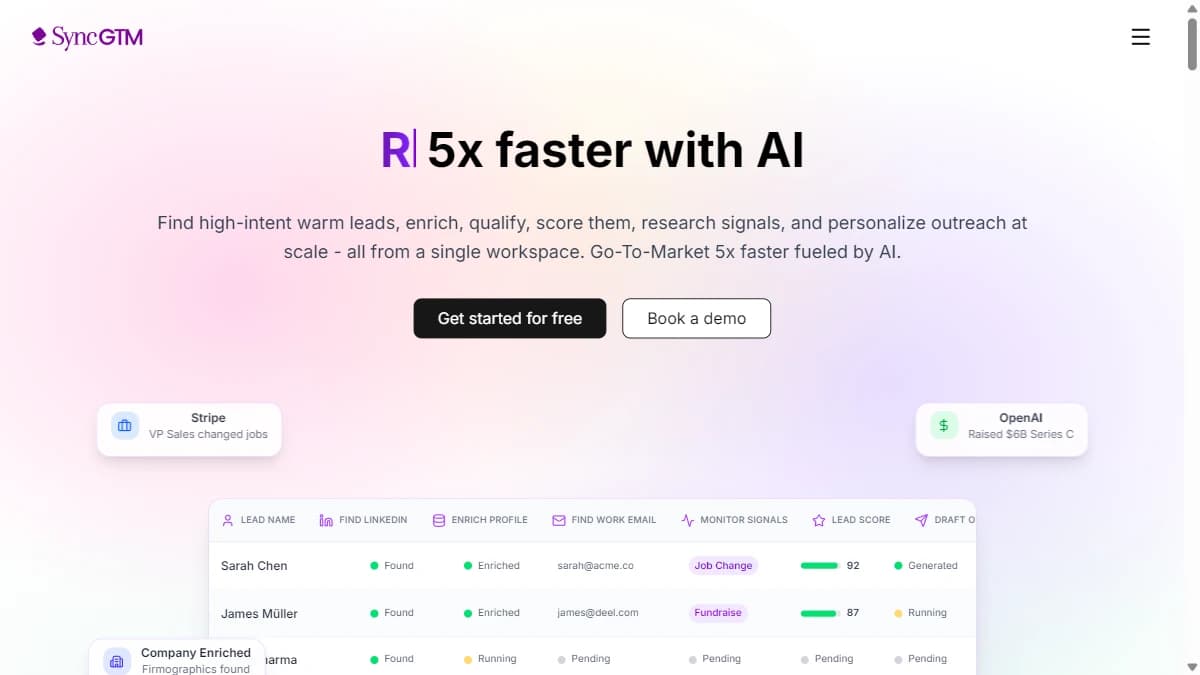
SyncGTM — AI research agents, waterfall enrichment, and CRM sync on every plan
SyncGTM is the best AI sales automation tool overall because it bundles the full rep-replacing stack on one platform — AI research agents, waterfall enrichment, signal-based triggers, and bidirectional CRM sync — with no feature gates on any plan.
Most automation tools force you to stitch three or four products together. SyncGTM handles prospecting, enrichment, and outreach on a single pane.
The platform runs AI agents that research accounts, personalize outreach using live signals (job changes, funding, tech stack shifts), and push sequences through your connected mailboxes. It also powers waterfall phone finding and email enrichment across 20+ data sources, which typically lifts hit rates 30–60% compared to any single-source tool.
Pricing starts at $99/month and every plan includes the full feature set — no separate tiers for AI agents, enrichment, or CRM sync. Teams that previously ran Clay + Apollo + Outreach typically collapse those line items into one SyncGTM subscription.
Pros
- ✓ Widest task coverage — agents + enrichment + outreach + CRM in one platform
- ✓ No feature gates — every plan has AI agents and waterfall enrichment
- ✓ Waterfall enrichment across 20+ data sources lifts hit rates 30–60%
- ✓ Published pricing from $99/month — no demo required to see rates
- ✓ Native HubSpot, Salesforce, and Slack integrations with bidirectional sync
Cons
- ✗ Smaller brand footprint than Apollo or Outreach
- ✗ Deepest value kicks in when you replace 2–3 existing tools
- ✗ Best suited to teams already doing outbound, not greenfield launches
Best for: B2B sales teams that want a single AI sales automation platform covering prospecting, enrichment, signals, and CRM sync without stitching tools together.
Pricing: From $99/month. Every plan includes AI agents, waterfall enrichment, and CRM integrations. Free tier available to test before committing.
2. Bardeen — Best for Non-Technical Browser Automation
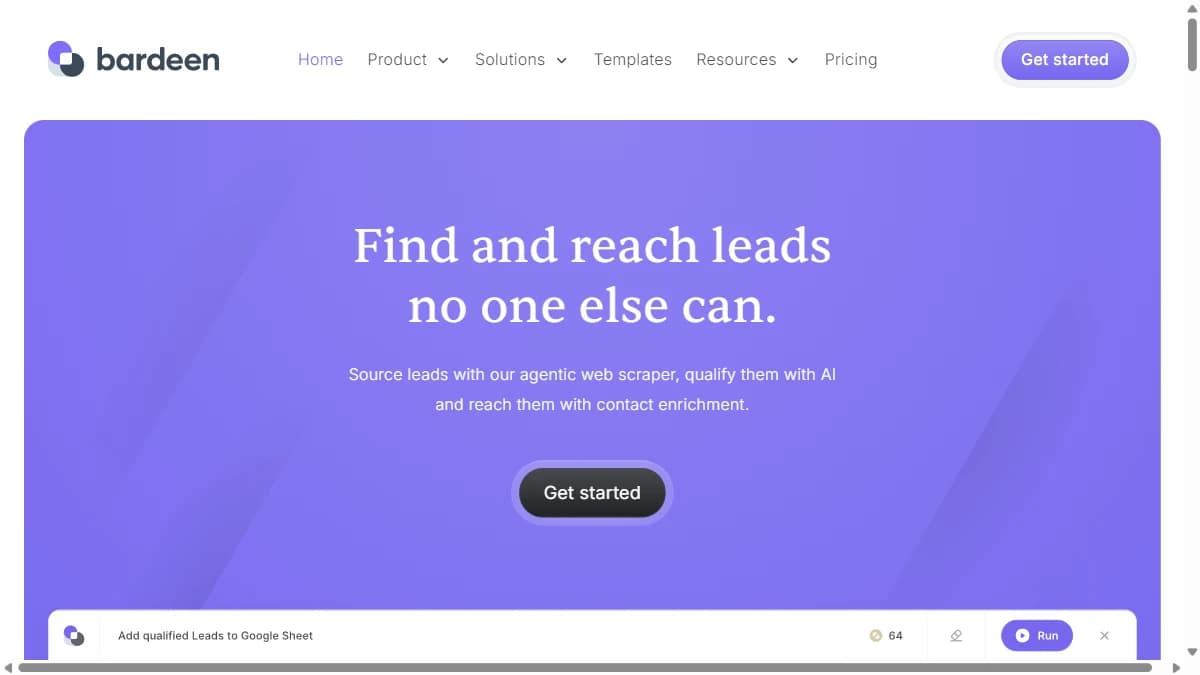
Bardeen — browser-native AI automation for sales and ops tasks
Bardeen is the best AI sales automation tool for non-technical teams that want to automate browser-level tasks — scraping LinkedIn, copying data between SaaS apps, auto-updating Notion or Google Sheets — without writing code.
It runs as a Chrome extension plus a cloud workflow layer.
Sales use cases include scraping LinkedIn Sales Navigator lists into CRM, auto-enriching contacts with public sources, and triggering Slack notifications on pipeline events. We reviewed Bardeen in detail — the short version is it shines for lightweight browser automation but hits limits when workflows need deep CRM logic or waterfall data routing.
Bardeen's AI layer uses GPT-4 to let you describe a workflow in natural language and generate the automation. That reduces the learning curve significantly versus tools like Zapier or Make, where you assemble each step manually.
Pros
- ✓ No-code — build automations by describing them in plain English
- ✓ Chrome extension captures browser-level actions natively
- ✓ Free tier covers basic automation; paid Pro at $149/month
- ✓ Large template library for sales and ops workflows
- ✓ Integrates with HubSpot, Salesforce, Notion, Airtable, and 100+ apps
Cons
- ✗ No native waterfall enrichment — you build data routing manually
- ✗ Cloud runs require paid plan; free tier is local browser only
- ✗ AI signals and ICP scoring require external tools to integrate
- ✗ Not purpose-built for outbound sequencing
Best for: Smaller sales and ops teams without engineering resources who want to automate specific browser-level tasks like scraping LinkedIn or auto-updating spreadsheets.
Pricing: Free tier available. Pro plan from $149/month. Business plan with premium actions from $500+/month.
3. Clay — Best for GTM Engineering Teams
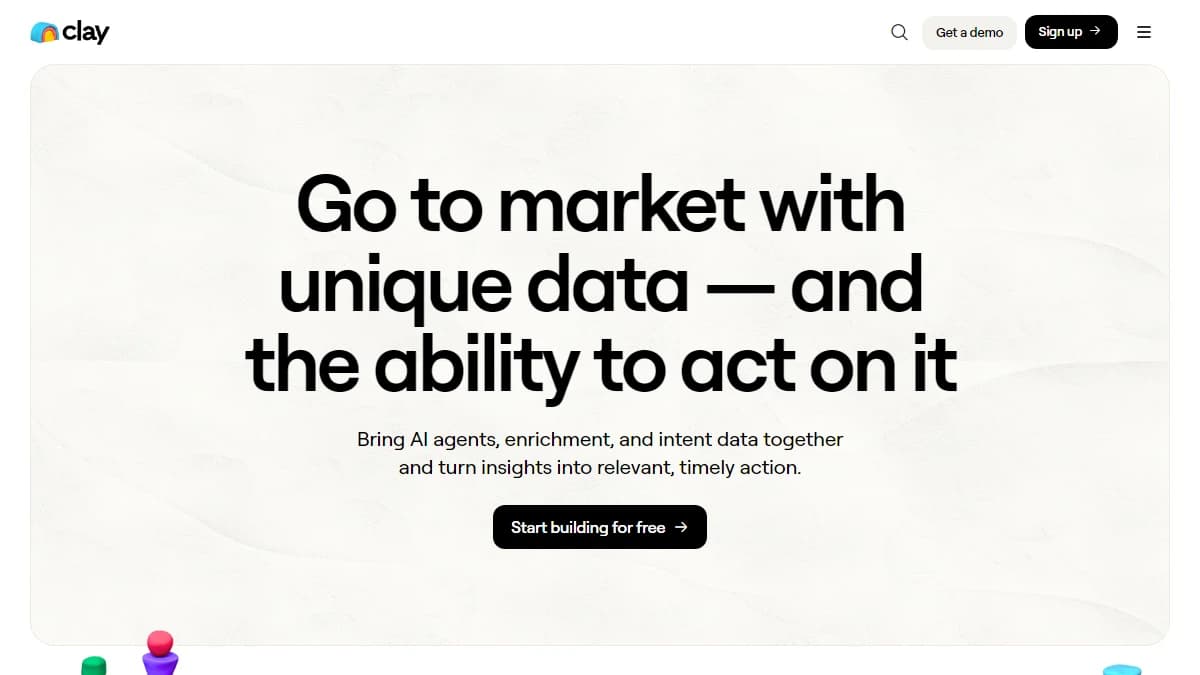
Clay — spreadsheet-native data enrichment and workflow platform
Clay is the most flexible AI sales automation platform on this list — 100+ data provider integrations, native AI agents, and a spreadsheet-like interface that lets GTM engineers build custom enrichment and outbound workflows.
Clay is powerful. That power comes with operational cost.
You or someone on your team needs to understand data routing, conditional logic, and credit management to get value out of it. Teams with a dedicated GTM engineer typically extract 5–10x more value than teams that treat Clay like a push-button tool.
Pricing starts at $349/month for the Explorer plan, with credits for enrichment separate from the seat fee. Most teams running real volume land in the $1,000–$3,000/month range once data credits are factored in. If you want Clay-style flexibility without the GTM engineering overhead, our Apollo alternatives post covers simpler options.
Pros
- ✓ 100+ data providers in one platform — widest data routing on the market
- ✓ Spreadsheet UI is familiar to anyone who's used Google Sheets
- ✓ AI agents can research, score, and personalize at the cell level
- ✓ Strong community and public playbook library
- ✓ Open API and webhook support for custom workflows
Cons
- ✗ Steep learning curve — requires a GTM engineer or heavy internal time
- ✗ Credit math gets expensive at scale; real usage rarely matches quoted cost
- ✗ Outbound sequencing is weaker — most teams still pair Clay with a sender
- ✗ Entry pricing starts at $349/month before data credits
Best for: Teams with a GTM engineer who want maximum flexibility and don't mind assembling the outbound sending layer separately.
Pricing: Starter at $349/month (Explorer). Pro at $800/month. Credits for enrichment priced separately. Enterprise plans custom.
Side-by-Side Comparison
| Tool | Best For | Task Coverage | GTM Engineer Required | Starting Price |
|---|---|---|---|---|
| SyncGTM | All-in-one AI sales automation | Full stack | No | $99/mo |
| Bardeen | Browser and SaaS automation | Partial | No | $149/mo |
| Clay | Custom data routing and enrichment | Data layer only | Yes | $349/mo |
How to Choose the Right AI Sales Automation Tool
Most teams overbuy. They pick the tool with the most features instead of the tool that actually replaces what their reps are doing manually.
Start with the task, not the product.
- If you want the widest task coverage →SyncGTM. One platform handles prospecting, enrichment, signals, and CRM sync from $99/month.
- If you need lightweight browser automation →Bardeen builds no-code workflows across your browser and SaaS apps for $149/month.
- If you have a GTM engineer and want flexibility →Clay lets you route across 100+ data providers from $349/month.
- If you're evaluating adjacent categories →Compare with AI SDR tools and AI sales prospecting tools for full pipeline coverage.
According to Gartner sales research, teams that consolidate three or more automation tools into one platform see 22% higher rep productivity and 31% lower total cost of ownership within 12 months.
Final Verdict
The best AI sales automation tool in 2026 is the one that replaces the most rep tasks with the least configuration.
For most B2B teams, that's SyncGTM. The task coverage is broad, the pricing is transparent at $99/month, and every plan ships with AI agents, waterfall enrichment, and CRM sync — no feature gates, no per-feature upsells.
Bardeen wins when your team needs lightweight browser automation and doesn't have engineering resources. It's the right choice for specific tasks — not a complete sales automation stack.
Clay rewards teams with GTM engineering capacity. Without that capacity, Clay becomes shelfware within three months.
Whatever you pick, audit the result in 90 days. Measure time-to-first-meeting, cost-per-enriched-record, and how many tools it actually replaced. If the automation didn't collapse your stack, it didn't do its job. For broader context on how AI is reshaping the sales function, see our rundown on how AI is changing sales.
This post was last reviewed in April 2026. Pricing and features may change — verify with each vendor before purchasing.