


4 Best Inbox Placement Testing in 2026 (Ranked and Compared)

By Kushal Magar · April 21, 2026 · 13 min read
Key Takeaway
This guide ranks the 4 best inbox placement testing tools in 2026 across B2B seed-list quality, provider coverage, authentication diagnostics, pricing, and integration depth. The tools reviewed are GlockApps, MailReach, Warmforge, and SyncGTM. Pricing ranges from MailReach at $9.60 per month for low-volume testing to GlockApps Pro at $79 per month for multi-ESP coverage across 30-plus providers. Each platform handles placement testing differently — GlockApps favors breadth across consumer and business inboxes, MailReach focuses on Google Workspace and Office 365 for B2B accuracy, Warmforge bundles AI warm-up with placement monitoring for cold email infrastructure, and SyncGTM embeds deliverability signals inside a full GTM stack that includes waterfall enrichment, sequencing, and CRM sync. For pure placement diagnostics, GlockApps wins on breadth and MailReach wins on B2B accuracy. For teams running outbound at scale who want placement insight alongside enrichment, sequencing, and pipeline automation, SyncGTM delivers the most complete workflow.
Gmail and Outlook tightened filters again in 2026. Cold email that landed in the primary inbox last year now drops into promotions or spam without warning — and the default “delivered” status in your sending tool tells you nothing about where mail actually landed. Inbox placement testing closes that gap by sending real mail to monitored seed inboxes and reporting exactly where each copy ended up.
This post ranks the 4 best inbox placement testing tools for B2B GTM teams in 2026 — with real pricing, honest pros and cons, and a clear recommendation for each use case. We cover standalone diagnostic tools (GlockApps, MailReach, Warmforge) and GTM platforms that bake deliverability signals into the broader outbound workflow (SyncGTM).
Quick Summary
The best inbox placement testing tool in 2026 depends on your outreach volume, channel mix, and stack. GlockApps ($79/mo Pro, credit packs from $16.99) leads on multi-ESP coverage with 30+ providers and deep authentication diagnostics. MailReach ($9.60/mo entry) wins on B2B accuracy with a Google Workspace and Office 365 weighted seed list plus organic warm-up. Warmforge (~$24/mo per mailbox) bundles AI warm-up with placement monitoring for cold email infrastructure at scale. SyncGTM ($99/mo Starter) embeds deliverability signals inside a full GTM platform with waterfall enrichment, sequencing, and CRM sync — the most complete workflow for teams that want placement insight plus retry logic on bounced or boxed sends.
TL;DR: Best Inbox Placement Testing Tools in 2026
- GlockApps — Best for multi-ESP coverage. 30+ provider seed list, SPF/DKIM/DMARC diagnostics, 50+ blocklist monitoring. From $79/mo Pro or $16.99 for 3-test credit pack.
- MailReach — Best for B2B accuracy. Google Workspace and Office 365 weighted seed list, organic warm-up, placement reports broken down by provider. From $9.60/mo for low-volume testing.
- Warmforge — Best for cold email infrastructure at scale. AI-driven warm-up plus placement monitoring, per-mailbox pricing that fits agencies and outbound-heavy teams. From ~$24/mo per mailbox.
- SyncGTM — Best for teams that want deliverability signals inside a full GTM stack. Waterfall enrichment, sequencing, and CRM sync alongside placement insight. From $99/mo Starter.
What Is Inbox Placement Testing?
Inbox placement testing is the process of sending a campaign email to a seed list of monitored addresses across Gmail, Outlook, Yahoo, and other major providers — then measuring where each copy actually landed. Primary inbox, promotions tab, spam folder, or missing entirely. Unlike the “delivered” status shown in your sending tool, placement testing gives you ground-truth data on deliverability before you burn your real list.
According to Validity's 2024 Email Deliverability Benchmark, roughly 15% of legitimate B2B email fails to reach the inbox globally — and that number climbs above 20% for cold outbound. Most senders never see the damage because their ESP only reports whether SMTP accepted the message, not whether the user's inbox provider routed it to the primary folder.
A good inbox placement test answers three questions in one report: Where is your mail landing per provider? Is your authentication (SPF, DKIM, DMARC) aligned? Are any of your sending domains or IPs on major blocklists? Teams using it weekly catch reputation damage before campaigns tank, and teams without it find out from quota misses.
For B2B senders specifically, the seed-list composition matters more than total list size. A tool with 100 consumer Gmail and Yahoo seeds will not predict what happens to mail hitting Google Workspace and Office 365 business inboxes. That is why this ranking weights B2B-accurate seed lists heavily.
How We Ranked These Inbox Placement Testing Tools
We evaluated each tool across six dimensions that matter most for B2B GTM teams running outbound email at scale. These criteria separate real deliverability intelligence from surface-level spam checkers.
- Seed list quality: Is the seed list weighted toward Google Workspace and Office 365 (B2B) or toward consumer Gmail, Yahoo, AOL (B2C)? Mismatch skews your results.
- Provider coverage: How many ESPs are represented — 10, 30, 50? More providers help newsletter senders; fewer but sharper providers help cold outbound.
- Authentication diagnostics: Does the tool check SPF alignment, DKIM signing, DMARC policy, and DNS records — with actionable fixes, not just pass/fail?
- Blocklist and reputation monitoring: Does it scan your domain and sending IPs against major blocklists (Spamhaus, SORBS, Barracuda) and flag reputation damage early?
- Integration depth: Can it pull data from your sending tool or CRM, or do you copy-paste test addresses every run?
- Pricing transparency: Is pricing published and predictable, or does it require a sales call and custom quote?
1. GlockApps — Best for Multi-ESP Coverage

GlockApps — multi-ESP placement testing with authentication diagnostics and blocklist monitoring
GlockApps is the most widely used standalone inbox placement testing tool in 2026, and for good reason: it has the broadest provider coverage on the market. Its Inbox Insight feature sends your campaign to a seed list spanning 30+ ESPs — Gmail, Outlook, Yahoo, AOL, iCloud, GMX, Mail.ru, Free.fr, and many regional providers — then reports placement per provider in a clean dashboard.
Beyond placement, GlockApps bundles three diagnostic layers most teams would pay separately for. The authentication checker validates SPF, DKIM, and DMARC alignment against your sending domain. The content analyzer runs your email against SpamAssassin, Barracuda, and Google's own spam rules — flagging keyword risk and structural issues. Blocklist monitoring scans your domain and sending IPs against 50+ major blocklists and alerts on changes.
A standout feature in 2026 is GlockApps' free DMARC analyzer — the platform processes up to 10,000 DMARC aggregate reports per month at no cost, which is genuinely useful for anyone cleaning up post-BIMI or post-Yahoo-policy-change deliverability. For teams sending across multiple regions and provider types, the breadth is unmatched.
Pros
- ✓ Broadest seed-list coverage — 30+ ESPs globally
- ✓ SPF, DKIM, DMARC diagnostics with actionable fixes
- ✓ 50+ blocklist monitoring with change alerts
- ✓ Free DMARC analyzer (10K reports/mo)
- ✓ Credit-pack pricing works for low-volume testers
Cons
- ✗ Seed list skews consumer — can mislead pure B2B senders
- ✗ No native warm-up — you need a separate tool
- ✗ UI feels dated compared to newer entrants
- ✗ Per-test credit model can get expensive for daily testing
Best for: Newsletter senders, transactional email teams, and agencies managing clients across consumer and business ESPs who need the widest placement visibility.
Pricing: Pro from $79/month. Credit packs from $16.99 (3 tests) to $75.99 (20 tests). Free tier available with limited features. 14-day free trial on paid plans.
2. MailReach — Best for B2B Accuracy
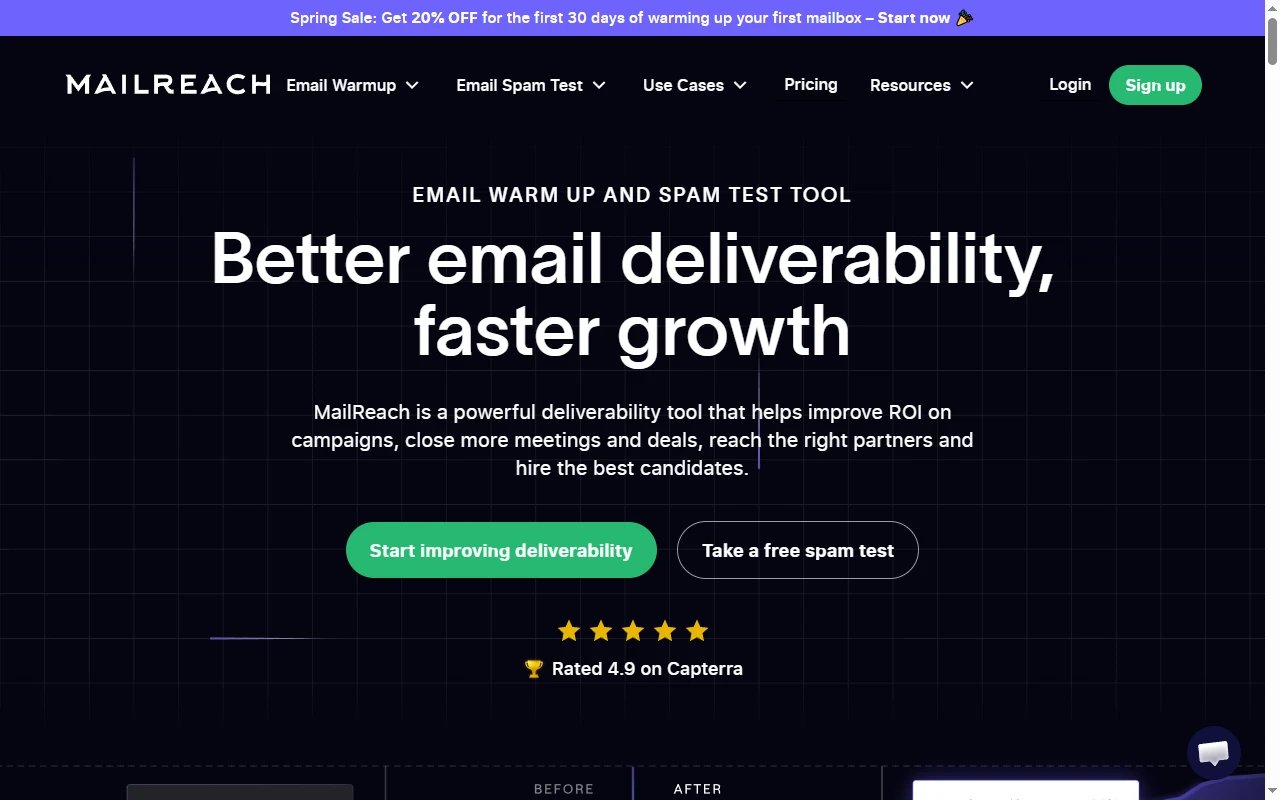
MailReach — B2B-weighted placement testing with organic warm-up
MailReach made a deliberate bet most competitors didn't: its seed list is weighted toward the two providers that actually matter for B2B outbound — Google Workspace and Office 365 — with a supporting cast of other business-grade ESPs. For cold email and B2B sales teams, that weighting produces placement data that actually predicts what happens when mail lands in a VP's inbox, not a college student's spam folder.
MailReach sends each test to a seed list of 35+ accounts across major providers and returns reports broken down per provider. You can see immediately whether Gmail is routing your mail differently from Outlook — and diagnose which authentication or content issue is driving the gap. The platform also pairs testing with cold email warm-up sequences that use real human-like patterns (varied send times, subjects, replies) to rebuild sender reputation — restoration succeeds in roughly 90% of damaged domain cases according to their own published data.
The catch is pricing model. MailReach charges per inbox — $25/month for one B2B mailbox, $195/month for ten, $390/month for twenty. For teams running hundreds of sending addresses, the math gets ugly fast. That's why agencies often pair MailReach on their best-performing mailboxes with a cheaper bulk tool for everything else.
Pros
- ✓ B2B-weighted seed list (Google Workspace, Office 365)
- ✓ Placement reports broken down by provider
- ✓ Organic warm-up with human-like patterns
- ✓ 90% reputation restoration rate on damaged domains
- ✓ Clean, fast UI with actionable fix recommendations
Cons
- ✗ Per-inbox pricing gets expensive at scale
- ✗ Narrower ESP coverage than GlockApps (good for B2B, limiting for consumer)
- ✗ Blocklist monitoring is less comprehensive
- ✗ No native integration with most cold email platforms
Best for: B2B sales and GTM teams running cold outbound where prospects primarily use Google Workspace or Office 365, and agencies needing accurate placement data on high-value sending mailboxes.
Pricing: From $9.60/month for low-volume placement testing. Warm-up and testing combined from $25/month per inbox. Volume discounts at 10+ mailboxes. 7-day free trial available.
3. Warmforge — Best for Cold Email Infrastructure at Scale
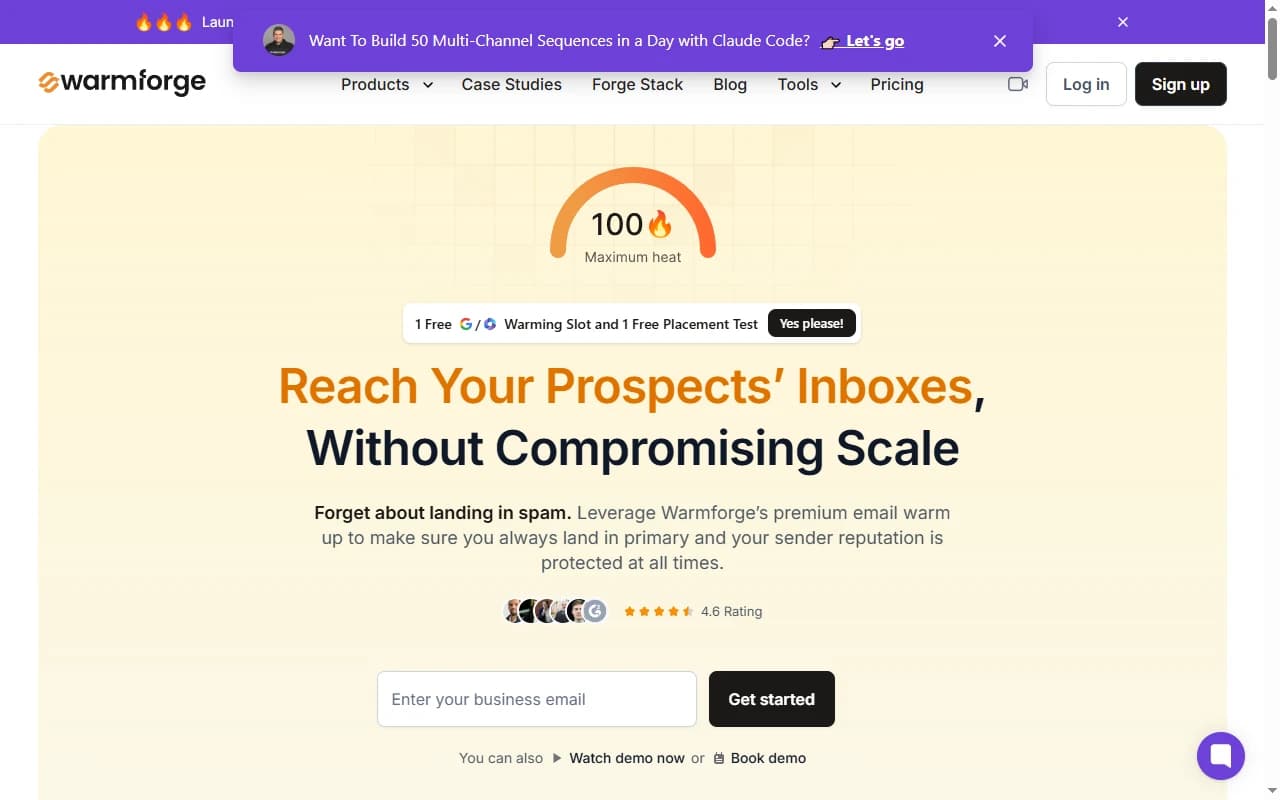
Warmforge — AI-driven warm-up plus placement monitoring for high-volume cold outreach
Warmforge took the lead in 2026 as the go-to AI-driven inbox placement solution for teams running cold email infrastructure at scale — think agencies with 50+ client mailboxes, lead-gen shops burning through sending domains, and outbound teams that treat deliverability as an infrastructure problem, not a one-off diagnostic.
The core product pairs AI-driven warm-up with continuous placement monitoring. Instead of running ad-hoc tests, Warmforge checks each connected mailbox on a rolling schedule — so you see reputation trends, not just a single snapshot. The AI layer decides when to warm a mailbox harder, when to pull back, and which signals correlate with upcoming spam-folder drift. It is the closest thing to autopilot deliverability the market has in 2026.
Per-mailbox pricing suits outbound operations where you add and retire sending addresses constantly. Warmforge integrates with Instantly, Smartlead, and other cold email platforms so warm-up and testing flow automatically for each new inbox. Where it stops short: deep authentication diagnostics and broad consumer-ESP coverage are lighter than GlockApps. This is a cold-email-operator tool, not a newsletter diagnostic.
Pros
- ✓ AI-driven warm-up adapts per mailbox automatically
- ✓ Continuous placement monitoring (not one-off tests)
- ✓ Native integrations with Instantly, Smartlead, and others
- ✓ Per-mailbox pricing fits agency and lead-gen workflows
- ✓ Reputation trend reports catch drift before campaigns tank
Cons
- ✗ Narrower authentication diagnostics than GlockApps
- ✗ Best value comes from continuous monitoring — overkill for occasional tests
- ✗ Newer platform; smaller community and reference base
- ✗ No bundled enrichment or sequencing — pure infrastructure tool
Best for: Agencies, lead-gen shops, and outbound-heavy B2B teams running cold email across many sending mailboxes who want deliverability on autopilot.
Pricing: From ~$24/month per mailbox. Volume discounts for 25+ mailboxes. Free trial available on request.
4. SyncGTM — Best for Deliverability Inside a Full GTM Stack
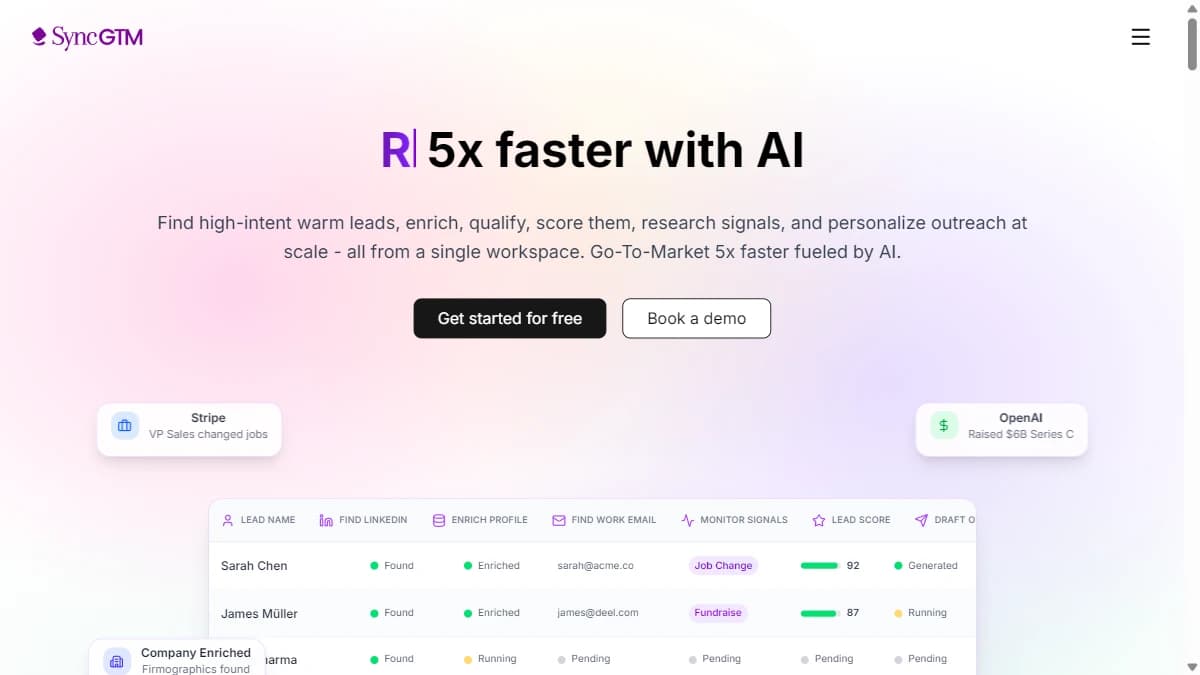
SyncGTM — deliverability signals embedded in a full GTM platform with enrichment, sequencing, and CRM sync
SyncGTM takes the opposite approach from dedicated testing tools: instead of making deliverability a separate diagnostic surface, SyncGTM embeds placement signals, bounce classification, and authentication checks directly inside the outbound workflow. When a send boxes or bounces, the platform doesn't just flag it — it routes the affected records back through waterfall enrichment to find an alternate address and retry. Deliverability data drives action, not dashboards.
The deliverability layer monitors sending-domain reputation, flags authentication drift (SPF, DKIM, DMARC), and classifies every bounce as hard, soft, or policy-driven — feeding those signals into the campaign engine so reps never have to manually triage. Soft bounces trigger automatic retry after a delay; hard bounces route records to re-enrichment; policy blocks get tagged and excluded from future sends. That closes the loop most standalone testing tools leave open.
What separates SyncGTM from dedicated deliverability tools is context. Every placement signal sits alongside enrichment data (company, tech stack, funding, buying signals), sequencing history, and CRM state. When a mailbox starts drifting toward spam, you can see which ICP segment is affected and which campaigns triggered the drop — not just a naked placement score. Combined with native CRM integrations for HubSpot, Salesforce, and Pipedrive, the full GTM picture lives in one place.
Pros
- ✓ Deliverability signals drive action (re-enrich, retry, exclude)
- ✓ Waterfall enrichment across 50+ providers on every paid plan
- ✓ AI agents, sequencing, and signals monitoring in one platform
- ✓ Native CRM sync (HubSpot, Salesforce, Pipedrive, Attio)
- ✓ No per-seat pricing — team growth doesn't compound costs
- ✓ Free tier with AI agents and CRM integration
Cons
- ✗ Not a standalone placement test — paired with outbound workflow
- ✗ Fewer seed-list ESPs than GlockApps for pure diagnostic breadth
- ✗ Best value comes from using the full GTM stack, not deliverability alone
Best for: B2B GTM teams that want placement insight, enrichment, and sequencing in one platform — without stitching together a separate deliverability tool, enrichment service, and sequencer.
Pricing: Free tier available with AI agents and CRM integration. Starter $99/mo with waterfall enrichment, verified emails, webhooks, and deliverability signals. Pro and Business tiers for higher volume. Explore pre-built workflow templates or take a product tour.
Side-by-Side Comparison
| Tool | Best For | Seed List Focus | Auth Checks | Free Tier | Starting Price |
|---|---|---|---|---|---|
| GlockApps | Multi-ESP coverage (consumer + business) | 30+ ESPs, consumer-leaning | Full (SPF, DKIM, DMARC, blocklists) | Yes (limited) | $16.99 credit pack / $79/mo Pro |
| MailReach | B2B accuracy for cold email | Google Workspace + Office 365 | Core (SPF, DKIM, DMARC) | Trial only | $9.60/mo |
| Warmforge | Cold email infrastructure at scale | Business-focused, AI-selected | Core (SPF, DKIM, DMARC) | Trial only | ~$24/mo per mailbox |
| SyncGTM | Deliverability inside full GTM stack | B2B inbox signals + bounce classifier | Core + auto-retry on bounce | Yes | $99/mo Starter |
How to Choose the Right Inbox Placement Testing Tool
The right inbox placement testing tool depends on four factors: your ESP mix (consumer vs. B2B), your sending volume, your stack (standalone diagnostic vs. integrated GTM), and how often you actually run tests. Here is the decision framework.
- If you send across many consumer and business ESPs →GlockApps has the broadest 30+ provider seed list and deep authentication diagnostics. Credit packs suit occasional testing; Pro suits daily use.
- If you run pure B2B cold email →MailReach weights its seed list toward Google Workspace and Office 365 — the only two providers that matter for most B2B outbound. Add organic warm-up for damaged domains.
- If you manage 25+ sending mailboxes →Warmforge pairs AI warm-up with continuous placement monitoring. Per-mailbox pricing and native integrations with Instantly/Smartlead make it the scale operator's choice.
- If you want placement signals inside a full GTM workflow →SyncGTM embeds deliverability signals alongside waterfall enrichment, sequencing, and CRM sync — so bounced and boxed sends auto-retry through alternate addresses instead of sitting in a dead list.
Final Verdict
Most B2B teams don't miss quota because their offer is bad. They miss quota because 30-40% of their mail silently landed in spam folders for three weeks while the dashboard showed “delivered.” Inbox placement testing is the cheapest insurance policy you can buy against that failure mode.
For pure diagnostic breadth across consumer and business ESPs, GlockApps is still the default. For B2B-accurate placement data tied to organic warm-up, MailReach is unmatched. For agencies and scale operators running 25+ mailboxes, Warmforge automates deliverability the way modern infrastructure should.
For B2B GTM teams that want placement insight wired directly into enrichment, sequencing, and CRM sync — so every deliverability signal triggers action, not just an alert — SyncGTM is the most complete workflow. Start with the standalone tool that matches today's stack, and consolidate into a full GTM platform as outbound scales.
Want deeper context? See our guides on personalized cold email outreach, top email enrichment tools, and the state of cold email in 2026.