4 Best Lead Database in 2026 (Ranked and Compared)

By Kushal Magar · April 21, 2026 · 14 min read
Your lead database is the foundation of every outbound motion. Bad data means bounced emails, wrong numbers, and reps wasting hours on contacts who left their company six months ago.
The problem is not a shortage of options. There are dozens of B2B lead databases in 2026. The problem is most of them recycle the same stale records, bury pricing behind demo calls, and claim accuracy rates that do not survive contact with a real inbox.
We ranked the 4 best lead databases in 2026 on what actually matters: data freshness, email and mobile hit rates, filter depth, integration quality, and transparent pricing.
This guide is for B2B sales and GTM teams evaluating their data stack — not a generic roundup padded with tools nobody uses.
TL;DR
| Tool | Best For | Starting Price | Verdict |
|---|---|---|---|
| SyncGTM | Signal-driven GTM, waterfall enrichment | Free tier + credit-based | Best overall for GTM teams |
| Apollo.io | SMB outbound, all-in-one prospecting | $99/user/month | Best value all-in-one |
| ZoomInfo | Enterprise ABM, org-chart depth | ~$15,000/year (custom) | Best for enterprise scale |
| Cognism | EMEA outbound, GDPR-compliant mobile | Custom pricing | Best for European markets |
What Is a Lead Database?
A lead database is a searchable repository of B2B contact and company records. It stores names, verified work emails, direct-dial phone numbers, job titles, company size, industry, technology stack, and — in modern platforms — intent and signal data.
Sales and marketing teams use lead databases to build targeted prospect lists, enrich inbound leads, and keep CRM records current.
The core problem with most lead databases is data decay. According to HubSpot research, B2B contact data decays at roughly 22.5% per year. People change jobs, companies rebrand, and email domains expire. A database that was 90% accurate 18 months ago is closer to 70% accurate today.
The best lead databases in 2026 tackle this through real-time verification layers, waterfall enrichment across multiple sources, or continuous re-validation of their record set. The ones that do not are selling you a spreadsheet with an API.
Key attributes to evaluate when choosing a lead database:
- Data freshness: How often are records verified or updated?
- Email hit rate: What percentage of exports return a valid, deliverable email?
- Mobile coverage: Does it include direct-dial numbers, not just switchboard lines?
- Filter depth: Can you filter by technographic, hiring signals, funding stage, or intent data?
- Integration depth: Does it push cleanly to your CRM and sequencing tool?
- Pricing model: Per-seat, per-credit, or per-export — and does it charge for misses?
How We Ranked These Tools
We evaluated these four lead databases on five dimensions, each weighted equally:
- Data quality: Verified email and mobile hit rates, data freshness practices, bounce rates reported by users on G2 and Capterra
- Feature depth: Filter capabilities, intent data, enrichment workflows, and waterfall options
- Integration quality: Native CRM connectors, API reliability, and sequencing tool syncs
- Pricing transparency: Whether real pricing is published or hidden behind demo walls
- GTM fit: How well the tool serves different team sizes and go-to-market motions (SMB outbound, enterprise ABM, EMEA, signal-driven)
We excluded tools that failed basic criteria: no pricing transparency whatsoever, widespread reports of high bounce rates (>10%), or no third-party reviews available.
Side-by-Side Comparison
| Feature | SyncGTM | Apollo.io | ZoomInfo | Cognism |
|---|---|---|---|---|
| Contact records | 50+ provider waterfall | 275M+ contacts | 265M+ contacts | 400M+ profiles |
| Email verification | Real-time, multi-source | Built-in verification | Continuous re-verification | Diamond Data verified |
| Mobile numbers | Waterfall coverage | Limited direct-dial | Strong mobile dataset | Diamond verified mobile |
| Intent data | 50+ signal types | Basic intent signals | ZoomInfo Intent (add-on) | Bombora-powered |
| CRM integrations | HubSpot, Salesforce, Pipedrive, Attio | HubSpot, Salesforce, Pipedrive | Salesforce, HubSpot, Dynamics | Salesforce, HubSpot, Dynamics |
| GDPR compliance | Depends on source provider | Standard compliance | Standard compliance | Purpose-built GDPR |
| Starting price | Free + credits | $99/user/month | ~$15K/year | Custom |
| Free tier | Yes | Yes (limited) | No | No |
1. SyncGTM
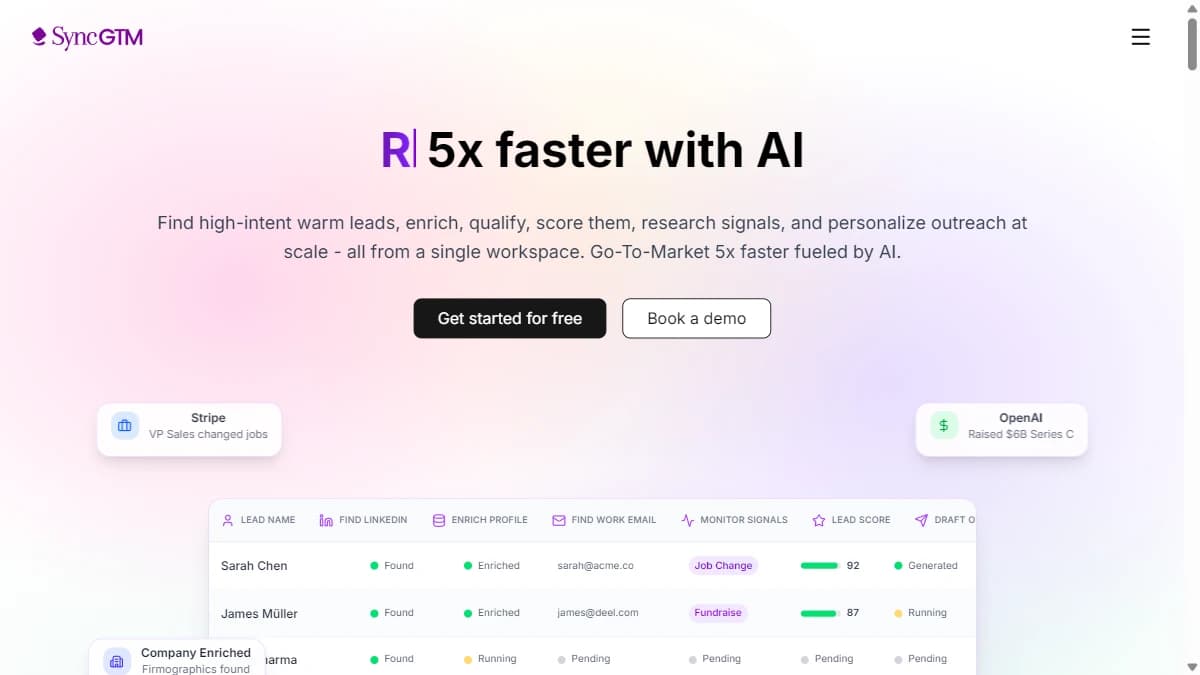
SyncGTM is a signal-driven GTM platform that combines a lead database, waterfall enrichment across 50+ data providers, and a workflow automation layer — all in one place.
Unlike traditional lead databases that give you a static export, SyncGTM builds dynamic lead lists using real-time signals: job changes, hiring patterns, funding announcements, technology installs, and website traffic growth.
When you find a match, SyncGTM enriches the contact through a cascading waterfall that queries multiple providers in sequence — returning a verified email and direct-dial mobile without charging for misses. The enriched contact then pushes directly to your CRM or sequencing tool.
This matters because the average single-source lead database returns a valid email for only 40–60% of records. SyncGTM's waterfall pushes that coverage to 80–95%, as detailed in our guide to waterfall contact providers.
Pros
- ✓ 50+ signal types for precise ICP targeting (not just firmographics)
- ✓ Waterfall enrichment across 50+ providers — highest coverage of any tool on this list
- ✓ Pay only for valid records returned, not for misses
- ✓ Built-in workflow automation — no need for a separate tool like Clay or Zapier
- ✓ Native integrations with HubSpot, Salesforce, Pipedrive, and Attio
- ✓ Free tier available — no credit card required to start
Cons
- ✗ Smaller proprietary database than Apollo or ZoomInfo for direct search
- ✗ Built-in sequencer is less mature than dedicated tools like Outreach or Salesloft
- ✗ Learning curve for teams unfamiliar with signal-based prospecting
Best for: GTM teams that want to move beyond static list-buying and trigger outreach based on real-time buying signals.
Pricing: Free tier available. Credit-based paid plans — pricing scales with enrichment volume. Only charged for successful record returns.
2. Apollo.io
Apollo.io is a sales intelligence platform combining a 275M+ contact lead database with built-in email sequencing, LinkedIn outreach, and a dialer. It is the most widely adopted mid-market lead database in 2026.
Apollo's search filters cover 65+ attributes: job title, company size, industry, technology stack, revenue range, keywords, and more. Its Chrome extension lets reps pull verified contacts directly from LinkedIn or company websites without leaving the browser.
The biggest trade-off is data quality at scale. Apollo's coverage is broad, but verified mobile numbers are thinner than claimed — especially outside North America. Teams running high-volume outbound typically supplement Apollo with a waterfall enrichment layer for mobile data.
For a deeper breakdown, see our full Apollo.io review.
Pros
- ✓ 275M+ contacts with 65+ search filters
- ✓ Built-in email sequencing and dialer — one platform for prospecting and outreach
- ✓ Chrome extension for LinkedIn and website prospecting
- ✓ Transparent per-seat pricing — no hidden credits for basic features
- ✓ Free tier with 50 exports/month — easy to test data quality before paying
Cons
- ✗ Mobile number coverage is weaker than ZoomInfo or Cognism for enterprise targets
- ✗ Email bounce rates can spike for niche industries or smaller markets outside the US
- ✗ Advanced features (intent data, AI recommendations) locked to higher tiers
- ✗ Reporting and analytics are basic compared to dedicated sales engagement tools
Best for: SMB and mid-market B2B teams that want a single platform for prospecting and outreach without a separate sequencing tool.
Pricing: Free tier available. Paid plans from $99/user/month (Basic) to $149/user/month (Professional). Enterprise pricing custom.
3. ZoomInfo
ZoomInfo is the largest dedicated lead database in the enterprise segment. Its 265M+ contact records are continuously re-verified through a combination of AI, web crawling, and a contributor network that gives ZoomInfo access to email patterns from corporate email clients.
ZoomInfo's differentiator is org-chart depth. You can map entire buying committees — from individual contributors to C-suite — at target accounts. This makes it invaluable for enterprise ABM programs with large deal sizes and long sales cycles.
The trade-off is price. ZoomInfo starts at approximately $15,000/year for a single user and typically runs $20,000–$40,000/year for small teams once required add-ons (intent data, Enrich, Engage) are factored in. For most teams, that math does not work unless the average contract value justifies the data investment.
For the full picture on pricing and where it falls short, see our ZoomInfo review.
Pros
- ✓ Best org-chart depth of any lead database — map full buying committees
- ✓ Continuous AI-powered re-verification reduces data decay impact
- ✓ ZoomInfo Intent (add-on) provides strong first-party and Bombora intent signals
- ✓ Deep Salesforce and HubSpot integrations with bi-directional sync
- ✓ Enrich product auto-updates CRM records as job changes are detected
Cons
- ✗ Expensive — minimum ~$15K/year, often $20K–$40K for small teams with add-ons
- ✗ Multi-year contracts are common; exiting early incurs penalties
- ✗ UI is complex — significant onboarding time for new users
- ✗ Overkill for teams with ACVs under $10K or small outbound volumes
Best for: Enterprise sales teams running ABM programs with $50K+ ACVs that need full buying committee mapping and intent data in one platform.
Pricing: No free tier. Custom pricing starting at ~$15,000/year per seat. Intent data, enrichment, and engagement modules are priced separately.
4. Cognism
Cognism is a GDPR-compliant B2B lead database built specifically for European outbound teams. Its Diamond Data program verifies mobile numbers by calling them — not just pattern-matching — and cross-references against do-not-call registries across the UK, Germany, France, and other EU markets.
That phone verification is Cognism's primary advantage. Most lead databases source mobile numbers algorithmically. Cognism's Diamond Data set is human-confirmed, which produces significantly higher connect rates on cold calls compared to unverified mobile databases.
Cognism also integrates Bombora-powered intent data, covering 300+ intent topics. You can layer topic intent on top of ICP filters to prioritize accounts actively researching your category before reaching out.
The downside: Cognism does not publish pricing. You need a demo call to get a number. Based on market reports and G2 reviews, annual plans typically run $15,000–$40,000 depending on seat count and data package.
For full details, see our Cognism review.
Pros
- ✓ Diamond Data mobile verification — highest confirmed mobile connect rates for EMEA
- ✓ Purpose-built GDPR compliance with DNC registry checks across EU markets
- ✓ Bombora intent data integration for topic-based prospect prioritization
- ✓ Strong EMEA database coverage — significantly better than US-centric tools for UK/DACH/Nordics
- ✓ Unrestricted data packages available — no per-export credit limits on some plans
Cons
- ✗ No published pricing — requires a demo call to get a quote
- ✗ North American database is thinner than Apollo or ZoomInfo
- ✗ No free tier — minimum commitment required to access data
- ✗ Diamond Data coverage is a subset of the full database; not every record is phone-verified
Best for: Sales teams running heavy phone outbound in EMEA markets where GDPR compliance and verified mobile numbers are non-negotiable.
Pricing: Custom — no published pricing. Estimated $15,000–$40,000/year based on G2 user reviews and market reports. Demo required.
How to Choose the Right Lead Database
The right lead database depends on your go-to-market motion, target geography, and team size. Here are the five decision criteria that matter most.
1. What is your primary outbound channel?
Email-heavy teams prioritize verified email coverage and bounce rates. Phone-heavy teams prioritize direct-dial and mobile numbers. If cold calling is your primary channel, Cognism's Diamond Data (EMEA) or ZoomInfo (North America) are the strongest choices. If email outreach drives most of your pipeline, Apollo or SyncGTM's waterfall will get you the highest coverage per dollar.
2. What is your primary market geography?
North America: Apollo and ZoomInfo both have strong coverage. EMEA: Cognism is the clear winner for verified mobile data and GDPR compliance. APAC or other regions: SyncGTM's multi-provider waterfall typically outperforms single-source tools by querying regional-specialist providers. For a full breakdown by region, see our guide to the best B2B contact databases.
3. What is your average contract value?
ACV under $10K: Apollo's $99/month pricing model works. The math does not support ZoomInfo's $15K+ minimum. ACV $10K–$50K: Apollo or SyncGTM, with intent data layered in. ACV $50K+: ZoomInfo's org-chart depth and intent signals start to justify the price for enterprise ABM programs.
4. Do you need intent data or signals beyond contact info?
Static contact databases are table stakes in 2026. The teams that consistently outperform their peers use buying signals — job changes, hiring patterns, funding events, technology installs — to time their outreach. SyncGTM offers 50+ signal types natively. ZoomInfo Intent and Cognism's Bombora integration are strong options if you are already committed to those platforms.
5. What is your budget flexibility?
Start with a free trial before committing to any annual contract. Apollo and SyncGTM both offer free tiers that let you test data quality against your specific ICP before paying. Check the full comparison of sales data providers if you want to evaluate beyond these four tools.
Final Verdict
The best lead database in 2026 is not the one with the most records. It is the one that returns verified contacts for your specific ICP, at the price point that makes your outbound math work.
SyncGTM wins for GTM teams that want signal-driven prospecting and waterfall enrichment in one workflow — with the highest coverage per credit of any tool on this list.
Apollo.io wins for SMB and mid-market teams that want a single platform for prospecting, sequencing, and basic intent data at a predictable per-seat price.
ZoomInfo wins for enterprise teams running complex ABM programs where org-chart depth and intent data justify the $15K+ annual price tag.
Cognism wins for any team with EMEA as a primary market that cannot afford GDPR risk or needs verified mobile numbers for cold calling.
Not sure where to start? SyncGTM's free tier lets you test real coverage against your ICP before committing to a paid plan — no credit card required.
For more context on how these tools fit into a broader data stack, see our guide to the top B2B data providers in 2026.