4 Best Lead Generation Web Tools in 2026 (Ranked and Compared)

By Kushal Magar · March 13, 2026 · 13 min read
Key Takeaway
This guide ranks and compares the four best lead generation web tools for B2B GTM teams in 2026: SyncGTM, Apollo, HubSpot, and ZoomInfo. A lead generation web tool turns anonymous website traffic and public B2B data into named, contactable leads by combining a contact database, website visitor deanonymization, inbound capture, enrichment, and CRM sync. The four tools differ across four axes: data quality and coverage, depth of enrichment and waterfall sourcing, integration and workflow depth, and pricing transparency. SyncGTM is the top pick because it combines B2B sourcing, waterfall enrichment across twenty-plus data providers, visitor identification, and native CRM integrations on every paid plan — starting at ninety-nine dollars per month with no feature gates. Apollo.io is the best volume prospecting tool with a genuinely free tier and a sales engagement sequencer built in. HubSpot is the strongest choice for inbound-led teams that want a unified CRM, marketing automation, and capture stack. ZoomInfo is the enterprise data pick when budget is not a constraint and deep direct-dial phone coverage plus intent data are required. The pattern that wins in 2026 is consolidation — one sourcing and enrichment platform, one engagement tool, one CRM — not a stack of ten point solutions.
B2B GTM budgets tightened in 2025 and 2026, and the biggest consolidation line item has been lead generation. Teams that ran ten point solutions — a prospecting tool, a separate enrichment tool, a visitor identification tool, a forms builder, a chat widget, a sequencer, a CRM sync layer — are cutting that stack in half. The tools that win are the ones that consolidate lead sourcing, enrichment, and activation into a single workflow, and publish honest pricing instead of hiding behind a demo form.
This post ranks the 4 best lead generation web tools in 2026 for B2B GTM teams. Each platform is evaluated on honest data quality, enrichment depth, integration coverage, and pricing transparency. We stripped out the marketing fluff: real prices, real match rates, and where each tool genuinely fits in a modern GTM motion.
Quick Summary
The best lead generation web tool depends on your motion. SyncGTM is the top overall pick — sourcing, waterfall enrichment, visitor ID, and CRM sync on every plan from $99/month. Apollo.io is the best free-to-paid prospecting tool with a sequencer built in. HubSpot is the pick for inbound-led teams that want CRM, marketing automation, and capture in one suite. ZoomInfo is the enterprise data pick when budget is not a constraint.
TL;DR: Best Lead Generation Web Tools in 2026
- SyncGTM — Best overall. B2B sourcing + waterfall enrichment across 20+ providers + visitor ID + CRM sync in one platform. From $99/month, no feature gates.
- Apollo.io — Best volume prospecting tool. Free tier, built-in sequencer, 275M+ contacts. Paid from $49/seat/month.
- HubSpot — Best for inbound-led teams. Full CRM, marketing automation, forms, and chat in one suite. Free CRM, paid tiers from $90/seat/month.
- ZoomInfo — Best enterprise data. Deepest direct-dial phone coverage and intent signals. Quote-only pricing from ~$15K/year.
What Is a Lead Generation Web Tool?
A lead generation web tool is software that turns anonymous website traffic and public B2B data into named, contactable leads. It combines one or more of five primitives: a verified B2B contact database, website visitor deanonymization, inbound capture (forms, chat, pop-ups), contact and company enrichment, and CRM or sequencer sync. Read more on how waterfall enrichment actually works.
The honest state of the category in 2026 is consolidation. Ten-tool stacks are losing to three-tool stacks — one platform for sourcing and enrichment, one for engagement, and one for CRM. The trigger is cost: running Apollo plus Clearbit plus ZoomInfo plus RB2B plus HubSpot Pro easily clears $40K/year for a five-person team. Consolidated platforms ship the same workflow at a third of the cost, and the data quality gap between single-source and waterfall-enriched providers has narrowed to under 5% on most B2B segments.
The category splits into three camps: data platforms (ZoomInfo, Apollo, Cognism) that sell access to a contact database; inbound-led suites (HubSpot, Salesforce Marketing Cloud) that bundle CRM, forms, and marketing automation; and modern GTM engineering platforms (SyncGTM, Clay) that combine sourcing, waterfall enrichment, visitor identification, and CRM sync in one workflow. For most B2B teams in 2026, the third camp wins on price-to-outcome.
How We Ranked the Tools
We scored each platform on five axes:
- Data quality & coverage — honest match rates on a mixed B2B test set, not vendor-claimed numbers.
- Enrichment depth — does the tool stop at a company name, or does it return a verified email, phone number, tech stack, and intent signal?
- Integration depth — native CRM sync (HubSpot, Salesforce, Pipedrive, Attio), sequencer push, Slack alerts, MCP or API access.
- Pricing transparency — published rates and usable free tiers beat demo-to-quote enterprise contracts.
- Time-to-pipeline — how fast a raw company name becomes an enriched CRM record and a sales task.
This guide focuses on tools a B2B GTM team can actually deploy in under a day without a three-month implementation project. For a broader look at the stack, see our roundup of the best sales leads generating tools and best B2B contact databases.
1. SyncGTM — Best Overall Lead Generation Web Platform
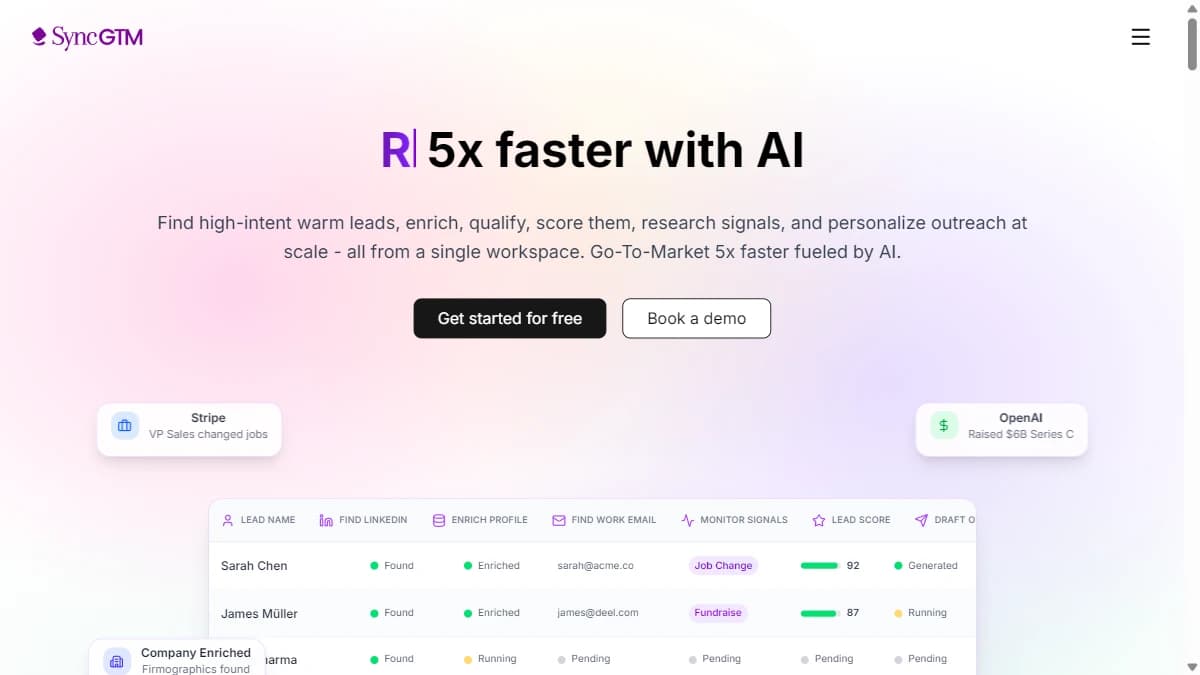
SyncGTM — B2B sourcing, waterfall enrichment, visitor ID, and CRM sync in one platform
SyncGTM is the only tool on this list that bundles B2B contact sourcing, waterfall enrichment across 20+ data providers, website visitor deanonymization, and native CRM integrations on every paid plan. That matters because lead generation is not one workflow — it is a chain. You need a company, then the right contacts, then a verified email and phone number, then a record pushed into your CRM. Stitching Apollo plus Clearbit plus ZoomInfo plus HubSpot with Zapier bills $40K/year and still drops 30% of records.
SyncGTM handles sourcing by querying its internal identity graph plus 20+ third-party providers (Apollo, ZoomInfo, Clay data, LinkedIn, and others) in a waterfall. If provider one returns a match, SyncGTM stops; if not, it falls through to provider two, and so on. The result is a verified email hit rate of 85–92% on ICP-fit US B2B contacts, up from 60–70% for any single provider. The platform then writes the enriched lead directly into Salesforce, HubSpot, Pipedrive, or Attio — no Zap required.
Pricing is fully published and there are no feature gates. The free tier covers 100 enriched leads per month. The $99/month plan adds unlimited CRM sync and the full waterfall. Compared to ZoomInfo ($15K+/year) or even the combined cost of Apollo plus HubSpot Pro, SyncGTM ships the same outcome at roughly one-tenth the cost. See full pricing or browse the workflow templates gallery.
Pros
- ✓ Sourcing + waterfall enrichment + visitor ID + CRM sync in one platform
- ✓ 20+ data providers bundled — no separate Apollo/ZoomInfo/Clearbit contracts
- ✓ Native HubSpot, Salesforce, Pipedrive, and Attio integrations
- ✓ Fully transparent pricing, no demo-to-quote gates
- ✓ Free tier with 100 enriched leads/mo and every integration included
Cons
- ✗ Newer entrant — smaller review footprint than HubSpot or ZoomInfo
- ✗ No built-in sales engagement sequencer (integrates with Apollo, Smartlead, Instantly)
- ✗ No built-in chatbot (integrates with Intercom/Drift instead)
Best for: B2B SaaS, RevOps, and GTM engineering teams that want sourcing, enrichment, visitor ID, and CRM sync in one predictable $99/month line item — without the 12-month ZoomInfo commitment or the $40K/year duct-taped stack.
Pricing: Free tier (100 enriched leads/mo). Paid from $99/month with no feature gates.
2. Apollo.io — Best Volume Prospecting Tool with a Free Tier
Apollo.io — 275M+ contact database with built-in sales engagement sequencer
Apollo.io is the volume prospecting tool that ate ZoomInfo's SMB and mid-market lunch since 2022. It ships a 275M+ contact database, a built-in sales engagement sequencer, a Chrome extension, and a genuinely usable free tier — all at a fraction of ZoomInfo's price. See the full Apollo.io review for the deep breakdown.
The free tier is genuinely useful: 100 email credits, 50 mobile credits per month, plus sequencer access with 500 active contacts. Paid plans start at $49/seat/month (Basic), $79/seat/month (Professional), and $119/seat/month (Organization). Match rates for verified business emails land at 70–80% on US SMB and mid-market ICPs, and 60–70% for EU contacts.
The trade-off is that Apollo is single-source. When a record misses in the Apollo database, there is no fallback to Clearbit or ZoomInfo — you need a waterfall layer like SyncGTM on top. CRM sync exists but is limited at lower tiers, and direct-dial phone coverage lags ZoomInfo by 15–20% in enterprise segments.
Pros
- ✓ Genuinely free tier — 100 email credits, 50 mobile credits per month
- ✓ 275M+ contact database, strongest growth in SMB and mid-market
- ✓ Built-in sales engagement sequencer with multi-channel cadences
- ✓ Chrome extension pulls emails directly from LinkedIn Sales Navigator
- ✓ Transparent pricing from $49/seat/month
Cons
- ✗ Single-source data — no waterfall fallback when a record misses
- ✗ Direct-dial phone coverage lags ZoomInfo in enterprise accounts
- ✗ CRM sync limited at lower tiers; advanced rules require Organization plan
- ✗ Sequencer deliverability occasionally flagged vs dedicated tools like Smartlead
Best for: SMB and mid-market B2B teams running outbound at volume that want a contact database and a sequencer in one tool, with a zero-cost on-ramp.
Pricing: Free tier (100 email / 50 mobile credits). Paid from $49/seat/month. Organization tier $119/seat/month.
3. HubSpot — Best Lead Generation Web Suite for Inbound-Led Teams
HubSpot — unified CRM, marketing automation, forms, and chat for inbound lead generation
HubSpot is the default inbound lead generation web suite — and for teams whose motion is content-led (SEO, webinars, newsletters, gated assets), it is still the strongest pick in 2026. It bundles a free CRM, forms, landing pages, email marketing, chatbots, and a marketing automation engine that rivals Marketo. Read the full HubSpot review for the deep breakdown.
The free CRM is genuinely generous — unlimited users, 1,000,000 contact records, and basic forms and chat. That alone covers most early-stage B2B teams. The paid upgrade path is expensive but predictable: Marketing Hub Professional starts at around $800 per month for 3 seats with 2,000 marketing contacts, and Sales Hub Professional is $90 per seat per month. Enterprise tiers clear $3,600/month.
The trade-off for outbound-led teams is that HubSpot is not a prospecting tool. The contact database (ZoomInfo Sales Intelligence integration) is thin outside of the Professional and Enterprise tiers, and the pricing ladder punishes scale — every marketing contact you import above the tier limit bumps the bill. For outbound motions, HubSpot is better paired with a sourcing layer like SyncGTM or Apollo rather than used as the primary generator.
Pros
- ✓ Free CRM covers unlimited users and 1M contact records
- ✓ Unified inbound suite — forms, landing pages, email, chat, automation
- ✓ Strongest marketing automation engine of any general CRM
- ✓ Huge ecosystem of native integrations (1,700+ apps)
- ✓ Best-in-class documentation, support, and certification program
Cons
- ✗ Not a prospecting tool — no native B2B contact database
- ✗ Marketing contact tier pricing punishes scale
- ✗ Marketing Hub Pro is $800+/mo before any real automation runs
- ✗ Sales Hub sequencer weaker than Apollo or Outreach at comparable tiers
Best for: Inbound-led B2B SaaS and services teams that want a single suite for CRM, forms, landing pages, email, chat, and marketing automation — and are willing to pay for the unified workflow.
Pricing: Free CRM. Marketing Hub Professional from $800/month (3 seats). Sales Hub Professional from $90/seat/month.
4. ZoomInfo — Best Enterprise Data for Lead Generation Web Workflows
ZoomInfo — enterprise-grade B2B contact database with intent data and WebSights visitor tracking
ZoomInfo is still the deepest B2B contact database on the market — the pick for enterprise teams with budget and a need for direct-dial phone coverage, technographic depth, and native intent data. It bundles SalesOS (the contact database), MarketingOS (account-based marketing), WebSights (visitor identification), and ZoomInfo Chat (inbound qualification) into one suite. See the ZoomInfo review for a deeper look.
Match rates are the highest in the category — direct-dial phone coverage lands at 60–70% for US enterprise contacts (versus 40–50% on Apollo), and technographic data depth is unmatched outside of BuiltWith. Intent signals come from the Bombora partnership and internal browsing data across ZoomInfo's publisher network. For enterprise ABM motions, no other tool comes close on raw data breadth.
The trade-off is cost and friction. Pricing is quote-only and typically starts at $15,000/year for a small team on SalesOS alone, scaling past $75,000/year once WebSights, intent data, and Engage are added. Contracts are annual. Self-serve does not exist; every evaluation runs through a 4–8 week enterprise sales process. Data freshness on SMB contacts has slipped behind Apollo and Cognism in independent tests over the last 18 months.
Pros
- ✓ Deepest direct-dial phone coverage in the category
- ✓ Unmatched technographic data (tech stack, spend signals, hiring intent)
- ✓ Native intent data via Bombora plus first-party browsing signals
- ✓ WebSights visitor identification bundled at enterprise tier
- ✓ Trusted, vetted data for regulated industries and enterprise legal review
Cons
- ✗ $15K+/year entry, $75K+/year for the full suite — too rich for SMBs
- ✗ Quote-only pricing, annual-only contracts, no self-serve onboarding
- ✗ SMB contact freshness has slipped behind Apollo and Cognism
- ✗ 4–8 week procurement cycle slows deployment
Best for: Enterprise B2B orgs and mid-market teams running account-based motions that need the deepest direct-dial coverage, technographic depth, and native intent data — and have a budget that starts at $15K/year.
Pricing: Quote-only. SalesOS typically from $15K/year, full suite $75K+/year.
Side-by-Side Comparison
| Tool | Free Tier | Paid Entry | Waterfall | CRM Sync | Best For |
|---|---|---|---|---|---|
| SyncGTM | 100 leads/mo | $99/mo | Yes, 20+ sources | Native, all plans | Best overall |
| Apollo.io | 100 email credits | $49/seat/mo | No (single-source) | Limited at low tiers | Volume prospecting |
| HubSpot | Free CRM | $800/mo (Mktg Pro) | No (inbound-led) | Native (it is the CRM) | Inbound suite |
| ZoomInfo | None | ~$15K/year | No (single-source) | Native, enterprise | Enterprise data |
How to Choose a Lead Generation Web Tool
Match the tool to your motion and your budget, not the longest feature list. Three decision points cover 90% of the choice:
- Is your motion inbound or outbound? If your pipeline comes from SEO, content, webinars, and gated assets, HubSpot wins. If pipeline comes from outbound prospecting and cold email, SyncGTM or Apollo wins.
- What is your ACV? At ACVs under $30K, a $15K/year ZoomInfo contract can eat a quarter of one closed deal's revenue — skip it. At ACVs over $100K with enterprise ICPs, ZoomInfo's data depth pays for itself on the first deal.
- Do you need sourcing plus enrichment plus CRM sync in one workflow? SyncGTM is the only tool on this list that ships all three on every plan. Apollo, HubSpot, and ZoomInfo each cover one or two of the three — and stitching them together in Zapier is the single biggest source of duct tape in B2B GTM stacks.
Don't pay for ZoomInfo if your ICP is mid-market SMB; don't run HubSpot Marketing Hub Pro if your motion is purely outbound; and don't stitch Apollo plus Clearbit plus RB2B with Zapier if a waterfall enrichment platform covers the same ground for less.
Final Verdict
For B2B GTM teams evaluating a lead generation web tool in 2026, SyncGTM is the top pick — the only platform that bundles B2B sourcing, waterfall enrichment, visitor identification, and native CRM sync on every paid plan with no feature gates, and at $99/month it replaces roughly $2,500/month of stitched-together tools.
Apollo.io wins as the volume prospecting plus sequencer tool with a genuinely free tier. HubSpot remains the pick for inbound-led teams that want CRM, forms, and marketing automation in one suite. ZoomInfo is the enterprise pick when budget is not a constraint and you need the deepest direct-dial and technographic data.
Whichever tool you pick, the 2026 pattern is consolidation: one sourcing and enrichment platform, one engagement tool, one CRM. If you want to collapse the first three lines of that stack into one predictable bill, start a free SyncGTM workspace and ship it by tomorrow.