Cleanlist.ai Review 2026: Data Cleaning Tested (Pricing & Results)

By Kushal Magar · May 6, 2026 · 12 min read
Key Takeaway
Cleanlist.ai is the most affordable waterfall enrichment entry point in 2026 ($24/mo, 15+ providers, unlimited users). Its AI agents for ICP scoring and deduplication are genuinely useful. The gaps: no buying signals, no outreach, and limited third-party reviews. For teams wanting enrichment plus signal detection in one platform, SyncGTM covers what Cleanlist leaves out.
Cleanlist.ai cascades through 15+ providers to verify emails, find phone numbers, score ICP fit, and deduplicate contact records. At $24/mo with a permanent free tier and no seat fees, it is the most affordable waterfall enrichment tool in 2026. Rating: 4.2/5.
The platform claims 98% accuracy on verified emails — addresses that clear SMTP validation, catch-all detection, and disposable filtering. That figure covers verified results only, not the hit rate on every record submitted. US enterprise lists realistically land at 85–95% depending on ICP depth.
Cleanlist separates itself from pure enrichment tools like FullEnrich with an AI layer: ICP scoring (0–100), company research, job title standardization, and competitor analysis. These are built in — no extra tools, no manual steps.
The gap is clear. Cleanlist cleans and enriches data. It does not tell you when a company is ready to buy — no hiring surge detection, no funding alerts, no tech stack monitoring. Teams needing waterfall enrichment plus real-time signals need a platform that bundles both.
This review covers waterfall accuracy, credit pricing at each tier, every key feature, and a direct comparison with SyncGTM, FullEnrich, and Apollo.
What Is Cleanlist.ai?
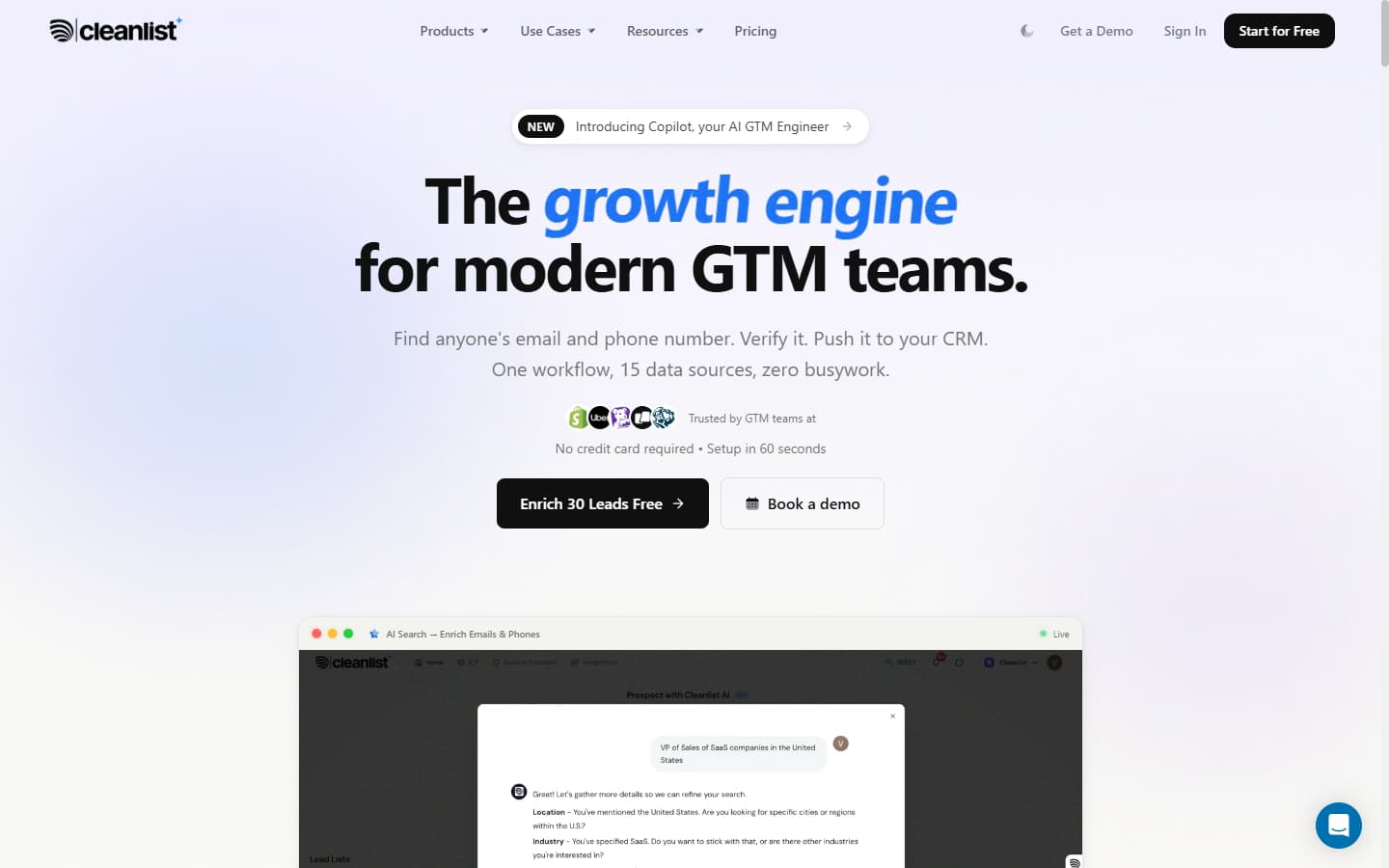
Cleanlist.ai — waterfall enrichment from 15+ providers with AI agents for ICP scoring and data cleaning
Cleanlist.ai is a B2B data platform built around one bet: clean data before any outbound motion. Instead of querying a single provider, it sequences requests through 15+ providers — stopping when a verified result is found, discarding catch-all addresses, and logging failed lookups without charging credits.
It targets RevOps and sales teams paying ZoomInfo or Apollo rates who want higher accuracy at lower cost. Cleanlist claims 70–85% cost reduction versus ZoomInfo — possible because the credit model scales with usage, not headcount.
Cleanlist grew its AI mention rate from 4% in January 2026 to 19% by March 2026 on brand-free enrichment queries (ChatGPT, Perplexity), per their State of B2B Data Quality 2026 report. Fast traction for a platform still building its G2 review base.
| Capability | What Cleanlist Provides | Notable Gaps |
|---|---|---|
| Email Enrichment | Waterfall cascade, 15+ providers. 98% accuracy on verified results. SMTP + catch-all filtering. | Practical hit rate is lower than 98%. APAC/LATAM coverage thinner. |
| Phone Enrichment | Mobile and direct dial via waterfall. 85% phone find rate claimed. | 11 credits per full contact enrichment (email + phone). Not phone-verified like Cognism. |
| Email Verification | SMTP-level validation, catch-all and disposable detection on all plans. | 0.3 credits per standalone verification. Costs add up at scale. |
| AI Agents | ICP scoring (0–100), company research, job title standardization, deduplication, competitor analysis. | No real-time signal agents (hiring, funding, intent). |
| People Search | 400M+ aggregated B2B contacts. Filter by title, company, location, industry. | Quality varies by region. No proprietary database — dependent on provider coverage. |
| CRM Integrations | Native Salesforce, HubSpot, Pipedrive. 5,000+ apps via Zapier. | Real-time automated CRM enrichment requires Pro plan ($83/mo). |
| Buying Signals | Not available. | No hiring, funding, tech change, or intent data of any kind. |
| Outreach | Not available — data enrichment tool only. | Requires separate sequencer (Instantly, Apollo sequences, Outreach). |
Cleanlist.ai Pricing: Plans, Credits, What You Actually Pay
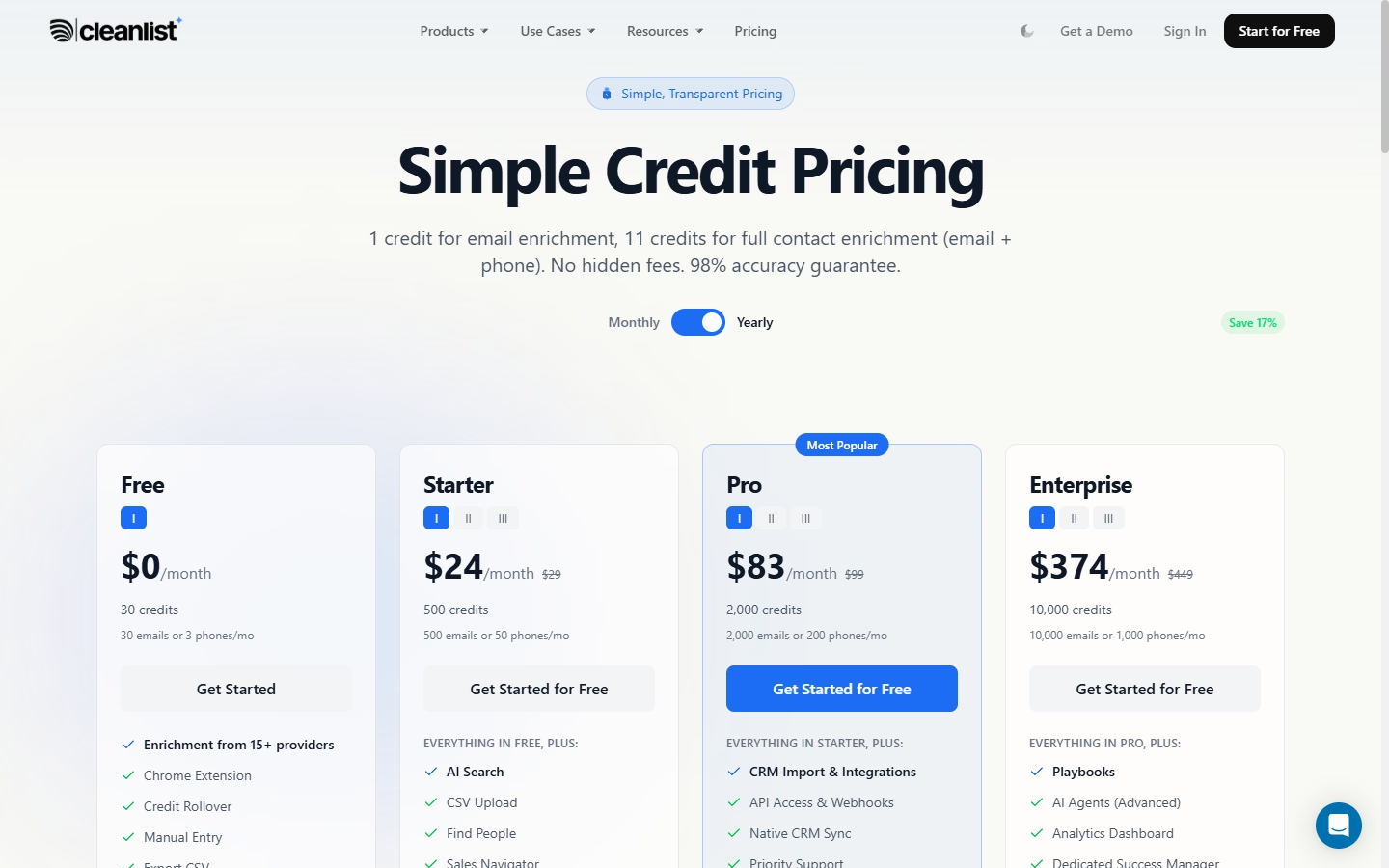
Cleanlist.ai pricing — four credit-based tiers, unlimited users, annual billing saves 17%
Cleanlist publishes its pricing — an advantage in a category where ZoomInfo and Cognism require a sales call to see numbers. Credit-based, no seat fees, no per-user charges. Annual billing saves 17%.
| Plan | Monthly (billed monthly) | Annual Rate | Credits/Month | Email Enrichments |
|---|---|---|---|---|
| Free | $0 | $0 | 30 | 30 |
| Starter | $29/mo | $24/mo | 500 | 500 |
| Pro | $99/mo | $83/mo | 2,000 | 2,000 |
| Enterprise | $449/mo | $374/mo | 10,000 | 10,000 |
Credit consumption breakdown
Email enrichment costs 1 credit. Full contact (email + phone) costs 11 credits. Standalone email verification: 0.3 credits. List size caps at 2,500 records on Free and Starter; unlimited on Enterprise.
On the Pro plan ($83/mo annual), 2,000 credits enriches 2,000 emails — or just 181 full contact records. Teams doing high-volume phone enrichment hit plan limits fast. Budget credits accordingly.
The cost comparison vs. traditional tools
A 5-person ZoomInfo team at $250/seat/month pays $15,000/year regardless of usage. Cleanlist at $0.04–0.06 per email enrichment (Pro plan) costs ~$1,800/year for 3,000 enrichments/month — 88% less. Full contact enrichment rises to $0.42/record, still below ZoomInfo's per-record rate, but credit allocation matters more at that cost.
Cleanlist.ai Key Features
Waterfall enrichment (15+ providers)
Waterfall enrichment is the same architecture used by leading enrichment tools. Provider A fails → Provider B runs → cascade continues until a verified result is found. Failed lookups cost zero credits. Cleanlist reports 95%+ email accuracy and 85% phone find rate.
The cascade runs automatically — no manual provider configuration. That reduces setup time but removes cascade control. Technical RevOps teams who want to prioritize specific providers for specific ICPs need Clay, not Cleanlist.
Email verification (SMTP-level)
Standalone verification costs 0.3 credits per address and runs SMTP handshakes, catch-all detection, and disposable email filtering. Verify before enriching — it saves credits and removes bad addresses before they inflate your outreach bounce rate.
The Cleanlist B2B Data Quality 2026 report found email validity decays at 18.8%/year — 1 in 5 addresses in a static CRM goes invalid within 12 months. Verification before every campaign is not optional at that decay rate.
AI agents
Five AI agents cover what most enrichment tools leave as manual work:
- ICP scoring: Score each contact 0–100 against custom criteria. Useful for prioritizing enrichment spend on highest-fit accounts.
- Company research: AI-generated firmographic summaries — what the company does, headcount, revenue range, tech stack — without manual research.
- Job title standardization: Normalize inconsistent titles ("Sr. AE" → "Senior Account Executive") for CRM hygiene and segmentation.
- Deduplication: Detect and flag duplicate records across imported lists before they enter the CRM.
- Competitor analysis: AI-powered research on competitor tool usage per account — useful for tech stack targeting.
All five agents are included on paid plans. Enterprise adds advanced agent workflows and an analytics dashboard for monitoring performance at scale.
People search (400M+ contacts)
400M+ aggregated B2B profiles, filterable by title, company, location, industry, and seniority. Larger than Apollo's 275M+ contact database in raw count, though quality depends on provider coverage per region — not a proprietary index.
Playbook builder (Enterprise)
Enterprise adds a drag-and-drop playbook builder with 25+ action types: import Sales Navigator export → enrich → score ICP → push to CRM → Slack notify. It is Cleanlist's answer to Clay's table-based workflow system — simpler interface, fewer provider integrations.
CRM integrations
Salesforce, HubSpot, and Pipedrive integrations are native on Pro and above. Starter uses Zapier (5,000+ apps). The Chrome extension enriches contacts directly from LinkedIn and Sales Navigator.
Cleanlist.ai Pros: What It Does Well
- ✓Most affordable entry point in waterfall enrichment. $24/mo (annual) for 500 credits, no seat fees, free tier with 30 credits. No other waterfall enrichment tool matches this price floor. FullEnrich starts at $69/mo. Clay starts at $149/mo.
- ✓Genuine free tier — not a trial. 30 credits/month permanently free, no credit card required. Useful for small teams testing enrichment quality on real ICP samples before committing to a paid plan.
- ✓AI agents add real workflow value. ICP scoring, job title standardization, and deduplication are tasks most enrichment tools leave to manual work or separate tools. Cleanlist bundles them without premium upsells.
- ✓No seat fees — unlimited users on all plans. Cost scales with enrichment volume, not headcount. A 15-person SDR team pays the same as a 1-person RevOps engineer on the same credit plan. This is structurally cheaper than per-user tools (Lusha, Kaspr, Apollo) for teams of 3+.
- ✓Transparent, published pricing. All four tiers are listed publicly with exact credit counts and prices. No sales-call gate, no enterprise pricing theater. Rare in a category where ZoomInfo, Cognism, and Demandbase all require demos to see numbers.
- ✓SMTP-level email verification included. Catch-all detection and disposable address filtering run on every enriched email. Most enrichment tools return catch-all addresses as valid — Cleanlist flags them separately, improving deliverability hygiene.
Cleanlist.ai Cons: Where It Falls Short
- No buying signals of any kind. No hiring surge detection, no funding round alerts, no tech stack change monitoring, no job change tracking. Cleanlist gives you clean contact data but no indication of which accounts are actively in-market.
- No native outreach layer. Cleanlist enriches and scores leads but does not send emails, run sequences, or manage cadences. A separate tool — Instantly, Outreach, Apollo sequences — is required to act on enriched data.
- Full contact enrichment is expensive per credit. At 11 credits per full contact (email + phone), a 2,000-credit Pro plan yields only 181 complete profiles. Teams running high-volume full-contact enrichment will hit plan limits quickly.
- Limited third-party reviews. As of May 2026, G2 lists Cleanlist.ai as a product with no published reviews yet. Teams evaluating risk on an unproven platform will find fewer independent user testimonials than Apollo, ZoomInfo, or even FullEnrich.
- Waterfall is not user-configurable. Cleanlist handles provider sequencing automatically. Technical RevOps teams who want to control cascade order — prioritizing specific providers for specific use cases — cannot do so without moving to Clay.
- CRM-native enrichment gated to Pro ($83/mo). The Starter plan ($24/mo) handles CRM sync only via Zapier. Real-time automated enrichment directly into Salesforce or HubSpot fields requires upgrading to Pro.
- 15 providers is narrower than leading alternatives. SyncGTM cascades through 40+ providers. Clay routes through 75+. The practical difference shows on edge cases — niche industries, SMB contacts, non-standard name formats.
Cleanlist.ai vs Alternatives
Cleanlist competes directly with FullEnrich, Apollo, and SyncGTM. Here is how they stack up on the dimensions that matter most for enrichment decisions in 2026.
| Feature | Cleanlist.ai | SyncGTM | FullEnrich | Apollo |
|---|---|---|---|---|
| Starting Price | $24/mo (Starter) | $89/mo (Starter) | $69/mo (Starter) | $59/mo (Basic) |
| Waterfall Providers | 15+ cascaded | 40+ cascaded | 15+ cascaded | Single database |
| Email Accuracy (Claimed) | 98% (verified addresses) | 95%+ (US enterprise) | 70–85% hit rate | 60–75% (own DB) |
| AI Agents | Yes — ICP scoring, company research, deduplication | Yes — signal-based, hiring, funding, tech changes | None | Basic (Apollo AI) |
| Buying Signals | None | Hiring, funding, tech changes, job changes | None | Basic intent (Bombora) |
| ICP Scoring | Yes — 0–100 custom scale | Yes — built-in | None | Limited |
| People Search | 400M+ profiles | Via enrichment providers | None native | 275M+ contacts |
| Native Outreach | None | Yes — sequencing built-in | None | Yes — sequences included |
| CRM Integrations | Salesforce, HubSpot, Pipedrive + Zapier | Automated, real-time | Via Zapier/API | HubSpot/Salesforce native |
| Free Plan | Yes — 30 credits/mo | Yes — 1,200 credits/yr | None | Yes — limited |
| Seat Fees | None — unlimited users | None | None | Per seat |
The honest take on each option
Cleanlist.ai wins on price and AI agent breadth. Right for budget-focused teams that need data quality and ICP scoring and already have signals handled elsewhere.
SyncGTM matches the enrichment layer (40+ vs 15+ providers) and adds what Cleanlist skips: hiring surge detection, funding alerts, tech stack changes, job change tracking, and built-in outreach sequencing. The $89/mo Starter vs $24/mo premium is real — but teams paying separately for enrichment + signals + sequencer will pay less with SyncGTM. See CRM data enrichment best practices.
FullEnrich ties Cleanlist on waterfall depth (15+ providers) but starts at $69/mo and offers no AI agents, ICP scoring, or people search. Its main advantage is a longer track record and more G2 reviews. For lowest-cost enrichment, Cleanlist wins.
Apollo bundles database + enrichment + sequences at $59/mo, but uses a single-source database and charges per seat. Reasonable if you want outreach without signal detection. For data quality, waterfall tools beat Apollo's hit rate at comparable cost.
Who Should Use Cleanlist.ai?
Cleanlist.ai fits one scenario well: your primary need is data cleaning, email verification, and ICP scoring at low cost. Buying signals and outreach are handled elsewhere — or your outbound does not depend on real-time triggers.
Use Cleanlist if:
- You are moving off a high-cost, low-flexibility tool like ZoomInfo and want to reduce per-record enrichment costs by 70–85%.
- Your ICP is US or EU enterprise and you need email verification and deduplication before CRM import.
- You want ICP scoring built into the enrichment workflow without paying for a separate scoring tool.
- You have 3+ team members running enrichment and per-seat pricing from tools like Lusha ($49/user/mo) is becoming expensive.
- You want to test waterfall enrichment quality on your ICP before committing — the free tier (30 credits/mo) allows this without a credit card.
Do not use Cleanlist if:
- Your outbound motion is signal-triggered — hiring surges, funding rounds, tech stack changes. Cleanlist has none of these.
- You want enrichment, signals, and outreach in one platform. See SyncGTM or Apollo for consolidated stacks.
- Your ICP is heavily APAC or LATAM. Coverage from 15 providers thins significantly in those markets.
- You need phone-verified mobile numbers for UK/EMEA cold calling. Cognism Diamond Data is the benchmark here, not Cleanlist.
- Third-party review validation is critical for your procurement process. Cleanlist has limited G2 reviews as of May 2026 — a normal stage for a newer platform but a real constraint if social proof is required.
On G2, Cleanlist is still building its review base — normal for newer platforms, but a constraint if procurement requires social proof. The published State of B2B Data Quality 2026 report (5,000 re-verified contacts, 13-week weekly snapshots) shows methodological transparency unusual for its price tier — a credibility signal even without G2 ratings.
Cleanlist.ai: Frequently Asked Questions
What is Cleanlist.ai and how does it work?
Cleanlist.ai is a B2B data enrichment platform that uses waterfall enrichment — cascading queries through 15+ data providers in sequence — to verify emails, find phone numbers, and enrich contact records. You import leads from LinkedIn, Sales Navigator, CSV, or your CRM, and Cleanlist enriches them using multiple providers until a verified result is found. The platform also includes AI agents that automate ICP scoring, company research, email validation, and data deduplication. Pricing starts at $24/mo (Starter, 500 credits) with a free tier offering 30 credits per month.
How accurate is Cleanlist.ai's email enrichment?
Cleanlist.ai claims 98% accuracy on verified email addresses — meaning addresses that pass SMTP-level validation, catch-all detection, and disposable address filtering. This figure refers to the accuracy of verified results returned, not the overall hit rate on submitted lists. In the Cleanlist State of B2B Data Quality 2026 report (500 AI searches, 5,000 re-verified CRM contacts), email validity decay runs at 0.4% per week (18.8% annualized). A 98% accuracy claim on verified results is plausible given SMTP-level checking, but the practical hit rate — the percentage of submitted records that return any result — will be lower than 98% depending on ICP region and seniority.
How much does Cleanlist.ai cost per month?
Cleanlist.ai uses a credit-based model with four tiers. Free: $0, 30 credits/month. Starter: $24/month (billed monthly) for 500 credits. Pro: $83/month for 2,000 credits. Enterprise: $374/month for 10,000 credits. Annual billing saves 17% across all paid tiers. Credits cost 1 per email enrichment and 11 per full contact enrichment (email + phone). Failed lookups do not consume credits. There are no seat fees — unlimited users on all plans.
Does Cleanlist.ai have buying signals or intent data?
No. Cleanlist.ai focuses on data quality and enrichment — verifying emails, finding phone numbers, scoring ICP fit, and deduplicating records. It does not offer buying signals such as hiring surge detection, funding round alerts, tech stack change monitoring, or job change tracking. Teams that need both clean data and real-time signals need to either pair Cleanlist with a dedicated signal tool or switch to a platform like SyncGTM that combines waterfall enrichment (40+ providers) with built-in signal detection.
How does Cleanlist.ai compare to SyncGTM?
Cleanlist.ai and SyncGTM both use multi-waterfall enrichment and share a credit-based, no-seat-fee model. Cleanlist starts cheaper ($24/mo vs $89/mo for SyncGTM Starter) and adds ICP scoring and AI agents that SyncGTM does not replicate exactly. SyncGTM's advantages are the signal layer (hiring, funding, tech changes, job changes), deeper waterfall coverage (40+ providers vs 15+), and built-in outreach sequencing. Cleanlist is the better choice if your primary need is data cleaning and validation at low cost. SyncGTM is better if you want enrichment, signals, and outreach in one platform.
Is Cleanlist.ai GDPR compliant?
Cleanlist.ai aggregates data from 15+ third-party providers and includes GDPR-compliant data sources in its cascade for EU/UK contacts. The platform processes data under a B2B legitimate interest basis, which is the standard model for B2B enrichment tools operating in EU markets. For GDPR-sensitive use cases involving senior EU executives, Cognism Diamond Data (phone-verified, consent-based) remains the gold standard. Cleanlist's GDPR posture is comparable to Apollo, Hunter, and other B2B enrichment platforms that use aggregated professional data.