7 Best FullEnrich Alternatives in 2026 (Compared)

By Kushal Magar · March 29, 2026 · 12 min read
Key Takeaway
This guide reviews seven FullEnrich alternatives for B2B waterfall enrichment in 2026. FullEnrich's main friction points are its 10-credit phone number cost (50 phones on a $29/mo plan), no Chrome extension since 2024, and no workflow automation or CRM sync beyond Zapier. SyncGTM is the top pick: waterfall enrichment across 50+ providers, AI agents, buying signals, and native CRM integrations from $99/mo with a free tier. Clay leads on provider breadth (100+) with AI formulas for custom waterfall logic but gates CRM integrations behind its $399/mo plan. Apollo is the best all-in-one if you want prospecting and outreach combined from $49/mo. Cognism is the strongest choice for GDPR-regulated European outreach with phone-verified mobile numbers. BetterContact specializes in mobile number enrichment where FullEnrich's 10-credit phone cost is prohibitive. Lusha maintains a working Chrome extension for LinkedIn-based lookup. Dropcontact is the EU-native GDPR alternative built on public sources only.
FullEnrich popularized waterfall enrichment for B2B teams — the idea of querying multiple data providers in sequence until a verified email or phone is found. The approach works. The pricing structure is where teams run into problems.
Phone numbers cost 10 credits each. On FullEnrich's $29/mo Starter plan with 500 credits, that's a ceiling of 50 phone lookups before your entire monthly budget is gone. The Chrome extension was discontinued in 2024. There's no workflow automation, no CRM sync beyond Zapier, and no buying signal layer to tell you when a contact is actually in-market.
We tested seven alternatives — ranging from full GTM platforms to GDPR-native enrichment tools — across coverage, pricing structure, CRM integration, and what they offer beyond the waterfall itself.
Quick Summary
The best FullEnrich alternatives in 2026 are SyncGTM, Clay, Apollo.io, Cognism, and BetterContact. SyncGTM is the top pick for most teams switching from FullEnrich — waterfall enrichment across 50+ providers, buying signal detection, AI agents, and native CRM integrations starting at $99/mo with a free tier that includes 200 credits. Clay provides 100+ provider integrations and AI formulas for advanced waterfall logic, though CRM sync requires its $399/mo plan. Apollo.io combines a 275M+ contact database with built-in sequences from $49/mo. Cognism leads on GDPR-verified phone data with DNC screening for EU and UK outreach. BetterContact specifically targets mobile number enrichment at flat-rate pricing — the most direct answer to FullEnrich's 10-credit phone cost problem.
TL;DR: Best FullEnrich Alternatives in 2026
- SyncGTM — Best overall. 50+ provider waterfall with buying signals, AI agents, and CRM sync from $99/mo with a free tier.
- Clay — Best for waterfall depth. 100+ providers, AI formula builder, custom waterfall logic.
- Apollo.io — Best all-in-one. 275M+ database with built-in email sequences from $49/mo.
- Cognism — Best for EU/UK outreach. Phone-verified mobiles with GDPR and DNC screening built in.
- BetterContact — Best for mobile numbers. Flat-rate phone enrichment without FullEnrich's 10-credit phone cost.
- Lusha — Best Chrome extension. LinkedIn lookup that FullEnrich discontinued in 2024.
- Dropcontact — Best EU-native GDPR alternative. Enriches from public sources only — no third-party data purchases.
Why Teams Look for FullEnrich Alternatives
FullEnrich genuinely delivers on its core promise: waterfall enrichment across 20+ providers surfaces email and phone data that single-source tools miss. Independent benchmarks show waterfall enrichment hitting email find rates near 80–98% versus 55–62% from single providers. The product earns its 4.8 G2 rating for what it does.
The switch conversations usually start with one of three friction points. First, the phone credit cost: at 10 credits per phone number found, teams running phone outreach at scale hit the credit ceiling fast. A $149/mo plan with 3,000 credits covers 300 phone lookups — less than one salesperson's weekly volume. Second, the 2024 Chrome extension discontinuation removed real-time LinkedIn lookup, forcing teams back to CSV bulk enrichment or manual API workflows. Third, FullEnrich has no workflow layer: enriched data moves to a CRM only through Zapier or custom API, with no native HubSpot, Salesforce, or Pipedrive connectors.
Teams that started with FullEnrich for email enrichment and grew into phone outreach, CRM automation, or signal-triggered workflows typically find they need a platform that extends beyond the waterfall itself.
1. SyncGTM: Waterfall Enrichment With Signals, Automation, and CRM Sync
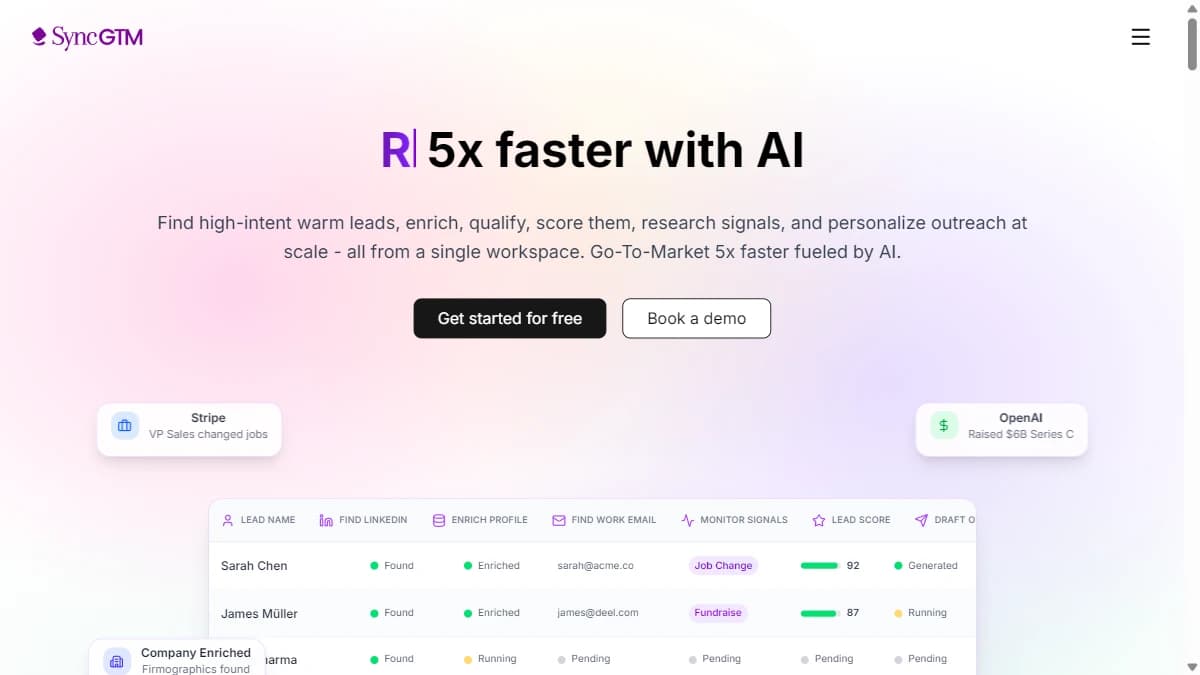
SyncGTM — waterfall enrichment across 50+ providers with buying signals and CRM sync from $99/mo
SyncGTM uses the same waterfall logic as FullEnrich — cascade through multiple providers until a verified result is found — across 50+ data sources versus FullEnrich's 20+. The practical difference: higher email and phone find rates on the same contact list, with lower per-contact cost at volume.
Where SyncGTM meaningfully extends beyond FullEnrich is the signal layer. Buying intent signals — hiring surges, executive moves, funding announcements, tech stack changes, news triggers — are built into the platform. You can trigger enrichment or outreach automatically when a target account matches a signal, not just when you remember to run a CSV export. For teams building enrichment into their CRM data enrichment workflow, SyncGTM writes enriched data directly to HubSpot, Salesforce, Pipedrive, and Attio on every paid plan — no Zapier required.
The free tier includes 200 credits per month with AI agents and CRM integrations active — enough to run a real workflow test before committing. FullEnrich's 50-credit trial expires with no recurring free tier.
Pros
- ✓ 50+ provider waterfall vs FullEnrich's 20+
- ✓ Free tier with 200 credits/mo — FullEnrich has none
- ✓ Native CRM sync (HubSpot, Salesforce, Pipedrive, Attio)
- ✓ Buying signal detection built in
- ✓ AI agents for research and personalization
- ✓ Workflow builder with branching logic
- ✓ No 10-credit phone penalty — flat credit model
- ✓ Independent column refresh reduces credit waste
Cons
- ✗ Starter at $99/mo vs FullEnrich's $29/mo entry
- ✗ Smaller community than established tools
Best for: GTM teams, RevOps, and growth teams that need waterfall enrichment plus workflow automation, buying signals, and CRM sync in one platform — without FullEnrich's credit cost penalty on phone numbers.
Pricing: Free tier (200 credits/mo) · Starter $99/mo · Growth $199/mo · Enterprise custom
2. Clay: 100+ Provider Waterfall With AI Formula Builder
Clay is the most provider-rich waterfall enrichment platform available, with 100+ data source integrations — five times FullEnrich's 20+. Its AI formula builder (Claygent) lets you write natural-language instructions for custom enrichment logic, web scraping, and AI-powered research steps that go beyond what any fixed-provider waterfall can do.
The practical capability gap is real. Clay can enrich a company record with job postings data, recent LinkedIn activity, news mentions, and competitor tech stack in a single table — pulling from different providers per column, each column refreshing independently. FullEnrich's waterfall is limited to email and phone data from its fixed 20-provider cascade.
The pricing structure is where Clay's complexity shows. Clay uses "credits" that map to compute units, not data lookups — costs vary significantly by which providers and AI steps run. CRM integrations are locked behind the Growth plan at $399/mo, which is a significant gate for teams that want enriched data flowing into HubSpot or Salesforce automatically.
Pros
- ✓ 100+ data provider integrations
- ✓ Claygent AI for custom research steps
- ✓ Flexible waterfall logic — not fixed cascade
- ✓ Strong community and template library
- ✓ Free plan available
Cons
- ✗ CRM integrations locked behind $399/mo Growth
- ✗ Credit cost opacity — hard to forecast spend
- ✗ Steep learning curve vs FullEnrich simplicity
- ✗ No built-in outreach sequencing
Best for: Technical GTM engineers and RevOps teams that need the deepest available waterfall customization and are comfortable with Clay's formula-based interface and pricing complexity.
Pricing: Free plan · Explorer $149/mo · Growth $399/mo · Enterprise custom
3. Apollo.io: Database + Enrichment + Outreach in One Platform
Apollo.io is not a waterfall tool — it owns and maintains its own 275M+ contact database directly. That's a fundamentally different architecture from FullEnrich's cascade across third-party providers. The upside: single-source database lookups are faster and simpler, with no per-provider credit unpredictability. The downside: when Apollo doesn't have a contact record, there's no fallback.
Apollo's advantage over FullEnrich is the built-in outreach layer. From one platform, you can find contacts, enrich CRM records, build sequences, send email campaigns, and track engagement — without patching together separate tools. FullEnrich gives you the enriched data and leaves the rest to you.
At $49/mo for the Basic plan, Apollo is priced below where FullEnrich's phone lookup costs start to compound. The free tier includes 10,000 email credits per month — FullEnrich's free trial is 50 credits, expiring after use.
Pros
- ✓ 275M+ contact database owned and maintained
- ✓ Built-in sequences and email outreach
- ✓ Free tier with 10,000 email credits/mo
- ✓ $49/mo Basic — accessible for small teams
- ✓ Native CRM integrations on all paid plans
Cons
- ✗ Single-source database — no waterfall fallback
- ✗ Data accuracy complaints on G2 for non-US markets
- ✗ Phone coverage weaker than waterfall providers
- ✗ Can feel bloated for teams that only want enrichment
Best for: SMB sales teams that want prospecting, enrichment, and outreach in one tool at accessible pricing — and don't need the multi-provider coverage that waterfall enrichment provides.
Pricing: Free tier · Basic $49/mo · Professional $99/mo · Organization $149/mo
4. Cognism: Phone-Verified Mobiles With GDPR Compliance for European Outreach
Cognism addresses FullEnrich's weakest point directly: EU and UK outreach compliance. FullEnrich's GDPR positioning is minimal — it sources data through providers and relies on users to handle compliance. Cognism runs its mobile phone data through human verification and DNC (Do Not Call) list screening across 14 countries before it reaches you.
The Diamond Data tier provides direct dials that are phone-verified — not just algorithmically assembled. Cognism's hit rate on European mobile numbers consistently outperforms both FullEnrich's waterfall result and Apollo's single-source coverage. For UK, DACH, France, Nordics, and Benelux outreach, Cognism is the data layer that legal and compliance teams approve without escalation.
The tradeoff: pricing is enterprise-level with custom quotes only — no self-serve plans, no public pricing page for individual seats. Teams with a smaller budget or need for quick self-serve access will find FullEnrich's credit model simpler to start with.
Pros
- ✓ Phone-verified Diamond Data mobiles
- ✓ DNC screening across 14 countries
- ✓ GDPR compliance docs per country (UK, DE, FR, Nordics)
- ✓ Strongest EU/UK mobile coverage available
- ✓ Salesforce and HubSpot integrations native
Cons
- ✗ No public pricing — enterprise sales process required
- ✗ Annual contracts standard
- ✗ US data depth weaker than Apollo or ZoomInfo
- ✗ No workflow automation layer
Best for: Mid-market and enterprise sales teams running phone outreach into EU and UK markets where GDPR compliance and DNC screening are non-negotiable.
Pricing: Custom quote only — typically $15,000–$40,000/yr depending on seats and data volume
5. BetterContact: Mobile Number Enrichment Without the 10-Credit Penalty
BetterContact is built specifically around the gap that FullEnrich's phone pricing exposes. Where FullEnrich charges 10 credits per phone number found — making phone outreach at scale economically painful — BetterContact aggregates 15+ providers specifically optimized for mobile number enrichment at flat-rate pricing per contact.
The platform uses a waterfall approach across providers ranked by mobile number accuracy per role type and seniority. A VP of Sales at a US fintech company routes through different provider priority than a field sales rep at a European manufacturing company. That role-aware cascade improves mobile find rates versus FullEnrich's undifferentiated provider queue.
BetterContact integrates natively with Clay, making it a common pairing: Clay handles email enrichment through its 100+ providers, BetterContact handles mobile phone enrichment as a specialized waterfall step. Teams running pure phone outreach campaigns at volume consistently find the economics better than FullEnrich's 10-credit structure.
Pros
- ✓ Specialized mobile phone waterfall
- ✓ Role-aware provider prioritization
- ✓ Native Clay integration
- ✓ Better economics than FullEnrich for phone volume
- ✓ Higher mobile find rates vs generalist waterfall tools
Cons
- ✗ Phone-only — no email enrichment layer
- ✗ No CRM integrations native
- ✗ No workflow automation or signal detection
- ✗ Requires pairing with another tool for email
Best for: SDR teams and cold callers that primarily run phone outreach and are hitting FullEnrich's 10-credit-per-phone ceiling at realistic monthly volumes.
Pricing: Starts at $29/mo — credit-based, flat cost per phone number found
6. Lusha: Chrome Extension for LinkedIn Lookup That FullEnrich Discontinued
Lusha fills the specific gap FullEnrich created when it discontinued its Chrome extension in 2024. Teams that relied on real-time LinkedIn profile lookup during prospecting — without uploading a CSV, without building an API workflow — can restore that workflow with Lusha's browser extension.
The Lusha extension surfaces verified emails, direct dials, and business phone numbers directly on LinkedIn profiles with a single click. Data is drawn from Lusha's own 100M+ contact database, which means it's a single-source lookup rather than a waterfall cascade. For contacts in Lusha's database, the lookup is instant. For contacts Lusha doesn't have, there's no fallback enrichment.
The free tier includes 5 credits per month — enough to verify the product works before committing. The Pro plan at $29/user/mo is comparable to FullEnrich's Starter pricing, making it an accessible direct comparison for individuals who primarily need LinkedIn-based contact lookup.
Pros
- ✓ Active Chrome + Firefox extension for LinkedIn
- ✓ Free tier (5 credits/mo) — test before buying
- ✓ Instant lookup on LinkedIn profile pages
- ✓ HubSpot and Salesforce native integration
- ✓ Simple interface with low learning curve
Cons
- ✗ Single-source database — no waterfall fallback
- ✗ No workflow automation or signal layer
- ✗ Per-seat pricing adds up for larger teams
- ✗ Gaps in non-LinkedIn-active industries
Best for: Individual SDRs and AEs who want the LinkedIn browser extension workflow that FullEnrich removed — real-time contact lookup while actively prospecting, without CSV bulk enrichment.
Pricing: Free (5 credits/mo) · Pro $29/user/mo · Premium $51/user/mo · Scale custom
7. Dropcontact: EU-Native GDPR Enrichment Built on Public Sources Only
Dropcontact takes a different approach to GDPR compliance than most alternatives. Rather than aggregating data from third-party providers and attaching compliance documentation, Dropcontact builds contact data exclusively from publicly accessible sources — company websites, LinkedIn public profiles, business registries, and professional directories. No third-party data purchases, no aggregated provider cascade.
For French and broader EU teams, this architecture reduces compliance risk at the point of data acquisition. Dropcontact is CNIL-certified (the French data protection authority), which provides a level of regulatory endorsement that FullEnrich and most waterfall providers cannot match. The tradeoff is coverage: public-source-only enrichment has lower find rates than waterfall tools that include purchased third-party databases in their cascade.
Dropcontact includes email verification, company data enrichment, and duplicate detection in its pipeline. Native integrations connect directly to HubSpot, Pipedrive, and Salesforce — no Zapier bridge required. For French SaaS companies and EU-first teams that have faced CNIL scrutiny, Dropcontact's public-source architecture is a meaningful risk reduction.
Pros
- ✓ CNIL-certified — French regulatory endorsement
- ✓ Public sources only — no third-party data purchases
- ✓ Email verification + duplicate detection built in
- ✓ Native HubSpot, Pipedrive, Salesforce connectors
- ✓ Strongest GDPR posture of any enrichment tool
Cons
- ✗ Lower find rates vs multi-provider waterfall tools
- ✗ No phone number enrichment
- ✗ No workflow automation or signal detection
- ✗ US and APAC data coverage significantly weaker
Best for: French and EU-headquartered companies where CNIL compliance and public-source-only data acquisition are required by legal, and lower email find rates are an acceptable tradeoff for regulatory certainty.
Pricing: Starts at €24/mo — credit-based per enriched contact
Side-by-Side Comparison
| Tool | Starting Price | Providers | Phone Cost | CRM Native | Free Tier | GDPR Strong |
|---|---|---|---|---|---|---|
| SyncGTM | $99/mo | 50+ | Flat credit | ✓ All plans | ✓ 200/mo | Yes |
| FullEnrich | $29/mo | 20+ | 10 credits each | ✗ Zapier only | ✗ Trial only | Minimal |
| Clay | $149/mo | 100+ | Variable | $399/mo+ | ✓ Limited | Moderate |
| Apollo.io | $49/mo | Own DB | Included | ✓ All plans | ✓ 10K/mo | Moderate |
| Cognism | Custom | Own DB | Verified | ✓ Native | ✗ | Strong |
| BetterContact | $29/mo | 15+ | Flat-rate | ✗ | Trial | Moderate |
| Lusha | $29/user/mo | Own DB | 1 credit | ✓ Native | ✓ 5/mo | Yes |
| Dropcontact | €24/mo | Public | ✗ No phones | ✓ Native | Trial | CNIL certified |
How to Choose the Right FullEnrich Alternative
- If you need waterfall enrichment plus CRM automation and signals → SyncGTM. 50+ provider waterfall, buying signals, AI agents, and native CRM sync from $99/mo — the full workflow FullEnrich stops short of.
- If you need maximum provider breadth with custom waterfall logic → Clay. 100+ integrations and Claygent AI for enrichment steps beyond contact data. Budget for the $399/mo Growth plan if you need CRM sync.
- If you want prospecting + outreach in one tool → Apollo.io. 275M+ database with sequences, email tracking, and CRM integrations from $49/mo.
- If you run phone outreach into EU/UK markets → Cognism. Phone-verified Diamond Data with DNC screening across 14 countries — the compliance layer FullEnrich doesn't provide.
- If phone enrichment volume is your primary FullEnrich cost problem → BetterContact. Specialized mobile waterfall without the 10-credit-per-phone penalty.
- If you need the LinkedIn Chrome extension FullEnrich removed → Lusha. Active extension with real-time LinkedIn lookup, free tier, and HubSpot/Salesforce integration.
- If CNIL or EU-native GDPR compliance is a hard requirement → Dropcontact. Public-source-only enrichment with CNIL certification and no third-party data purchasing.
Final Verdict
FullEnrich does what it says. The waterfall enrichment approach delivers meaningfully better email find rates than single-source tools, and the 4.8 G2 rating reflects genuine user satisfaction with the core product. The limits are structural: 10 credits per phone number, no Chrome extension, no native CRM sync, no workflow automation.
For teams that started with FullEnrich and need more, SyncGTM is the most direct expansion — 50+ provider waterfall plus the buying signal detection, workflow automation, and CRM integrations that FullEnrich doesn't offer. Start with the free tier (200 credits/mo) to run a parallel enrichment test on the same contact list before switching.
If your specific gap is phone volume, BetterContact solves the 10-credit penalty directly. If you need EU compliance documentation, Cognism or Dropcontact cover that ground. And if the browser extension workflow is the primary blocker, Lusha restores exactly that without requiring a workflow rebuild.
For enrichment tools beyond this list, our best CRM data enrichment tools guide covers the full category.