3 Best Lead Mail Tools in 2026 (Ranked and Compared)

By Kushal Magar · April 17, 2026 · 12 min read
Key Takeaway
This guide ranks and compares the three best lead mail tools for 2026: SyncGTM, Apollo.io, and Hunter.io. Each wins on a different job. SyncGTM is the top overall pick because it bundles verified lead discovery across twenty-plus data sources with mailbox rotation, autoresponder sequences, and native CRM sync on every paid plan, starting at ninety-nine dollars per month with no feature gates and no stitching work. Apollo.io is the best value contact database with two hundred ten million records, ninety-one percent email accuracy, and a native sequencer from forty-nine dollars per user per month. Hunter.io is the simplest pure-play email finder with domain search, confidence scores, and a Chrome extension from thirty-four dollars per month. Ranking criteria: data accuracy, enrichment depth, sending infrastructure, integration quality, and pricing transparency. Match each tool to your motion — full B2B GTM with cold outbound, a standalone contact database next to an existing sequencer, or pure email lookup on a budget — and ignore the inflated feature lists that do not match the workflow you actually run.
Every "best lead mail" roundup online lists twelve tools, publishes a 20,000-word pile of marketing bullet points, and leaves you more confused than before. The truth is simpler. In 2026 the lead mail category compresses into three real archetypes — the full GTM engine, the big contact database, and the pure email finder — and ninety percent of teams need exactly one of them. Pick the wrong archetype and you will either overpay by a factor of three or ship a broken outbound motion.
This guide ranks the three best lead mail tools in 2026 — SyncGTM, Apollo.io, and Hunter.io — evaluated on data accuracy, enrichment depth, sending infrastructure, integration quality, and pricing transparency. Real prices. No demo-gated numbers. We also flag where each tool genuinely fits the motion you already run, so you do not buy a contact database when you only needed a finder, or a finder when you needed an end-to-end engine.
Quick Summary
The best lead mail tool depends on your motion. SyncGTM is the top overall pick — waterfall enrichment across 20+ sources, mailbox rotation, autoresponder sequences, and CRM sync from $99/month. Apollo.io is the best value contact database at 210M+ records and $49/user/month. Hunter.io is the simplest pure-play email finder from $34/month.
TL;DR: Best Lead Mail Tools in 2026
- SyncGTM — Best overall. Lead mail discovery + waterfall enrichment + inbox rotation + autoresponder + CRM sync in one platform. From $99/month, no feature gates.
- Apollo.io — Best value contact database. 210M+ contacts, 91% email accuracy, native sequencer. From $49/user/month with a 100-credit free tier.
- Hunter.io — Simplest pure-play email finder. Domain search, confidence scores, Chrome extension. From $34/month with 50 free searches/month.
What Is a Lead Mail Tool?
A lead mail tool is any software that turns a target account or persona into a verified work email address — and in most cases lets you contact that lead directly from the same platform. The 2026 category splits into three clear archetypes, and the biggest mistake buyers make is treating them as interchangeable.
Pure-play email finders (Hunter.io, Snov.io, Voila Norbert) take a name and domain and return a confidence-scored email. They do one thing well and ship a Chrome extension so SDRs can grab addresses from LinkedIn. They usually do not ship a serious sequencer, so pair them with Smartlead, Instantly, or your own mail client.
Contact databases with engagement (Apollo.io, ZoomInfo, Cognism, Lusha) ship hundreds of millions of pre-indexed B2B contacts filterable by title, industry, headcount, technographic signals, and intent. Most include a lightweight sequencer on top, so a solo SDR can search, enrich, and send from one UI.
End-to-end GTM engines (SyncGTM) layer waterfall enrichment across 20+ providers on top of a real outbound stack — mailbox rotation, autoresponder sequences, reply-based branching, AI reply categorization, and native CRM sync. The pitch is "one vendor replaces Apollo + Smartlead + Clay + HubSpot Ops Hub," which is exactly how most B2B teams end up with a five-figure annual data spend.
If you only need the address, pick a finder. If you need contacts plus basic sending, pick a database. If you are running a real B2B GTM motion — enrichment, cold outbound, replies, CRM sync — pick an engine.
How We Ranked the Tools
We scored each platform on five axes that determine whether a lead mail tool actually drives pipeline or just drains credits:
- Data accuracy — published verification rate, freshness cadence, and real-world bounce performance. Static databases without real-time SMTP checks lose points.
- Enrichment depth — does the tool stop at a single provider, or does it cascade through multiple sources (waterfall) to maximize coverage?
- Sending infrastructure — mailbox rotation, domain warmup, reply handling, and deliverability at scale. Finders without a serious sender lose points.
- Integration quality — native two-way CRM sync (HubSpot, Salesforce, Pipedrive, Attio), not a one-way Zap. Reply and opt-out propagation is the test.
- Pricing transparency — published rates and functional free tiers beat demo-to-quote gates. Credit gymnastics and seat-based tiering lose points.
This guide covers the tools a GTM team can ship on without a six-figure procurement cycle. For the broader database landscape, see B2B contact list providers, and for the cold-email layer specifically, see our automated outreach breakdown.
1. SyncGTM — Best Overall Lead Mail Tool for B2B GTM
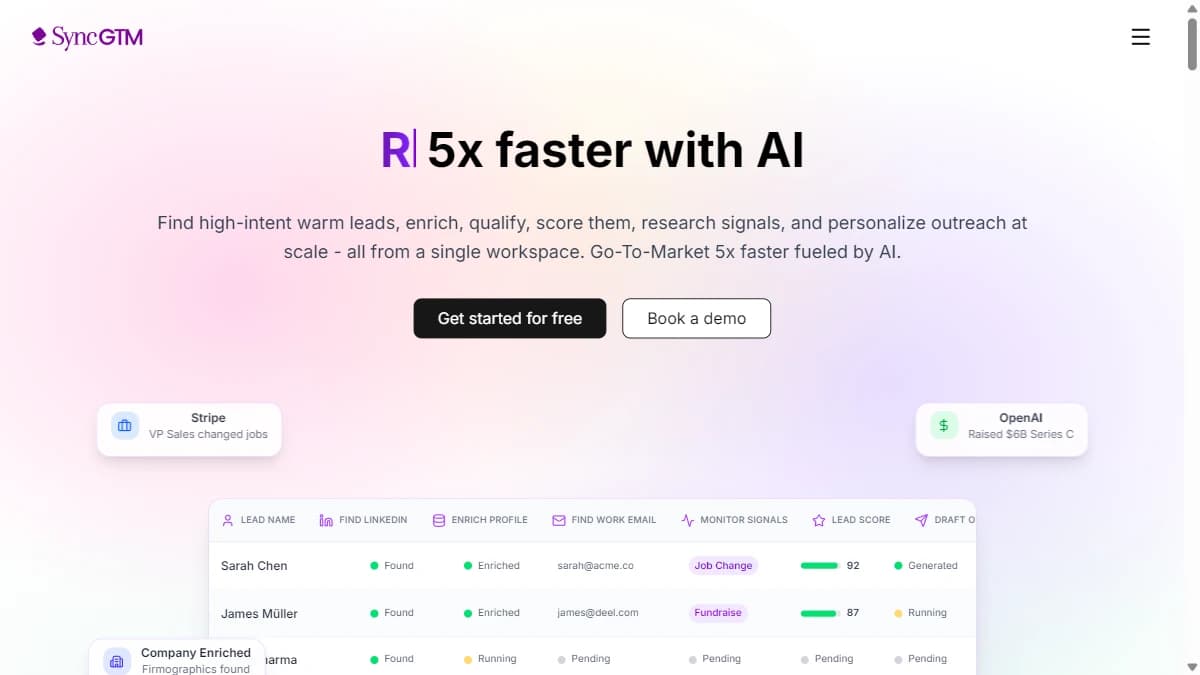
SyncGTM — lead mail discovery with waterfall enrichment, mailbox rotation, and native CRM sync
SyncGTM is the only platform on this list that pairs verified lead mail discovery with the infrastructure B2B teams actually need downstream — inbox rotation, waterfall enrichment across 20+ data providers, an autoresponder engine with reply-based branching, and native CRM integrations on every paid plan. A pure finder gives you an email. A database gives you a list. SyncGTM gives you the motion — contact, enriched, sent, replied to, synced.
Waterfall enrichment is the accuracy story. Instead of trusting one provider, SyncGTM calls Apollo, ZoomInfo, Clay providers, LinkedIn, Dropcontact, FullEnrich, Hunter, and 15+ other sources in priority order, then cross-verifies every address with a real-time SMTP check. Production campaigns typically land under 3% bounce rates — noticeably better than any single-provider database. The same enrichment run also returns titles, seniority, company size, technographic signals, and LinkedIn URLs, so one credit pull powers both your targeting and your personalization.
Sending is native. Rotate unlimited connected mailboxes with automated warmup, ship reply-based branching that pauses prospects who respond, AI-categorize reply intent (interested, not now, wrong person, OOO), and auto-resume out-of-office threads on the return date. Replies, bounces, and opt-outs sync to Salesforce, HubSpot, Pipedrive, or Attio in real time as activity records — not a one-way contact push.
Pricing is fully published and there are no feature gates. The free tier covers 100 sends per month with every integration included. The $99/month plan unlocks unlimited CRM sync, waterfall enrichment, and mailbox rotation. Compared to a stitched stack of Apollo ($49+/user) + Smartlead ($39+/mo) + Clay ($149+/mo) + HubSpot Ops Hub ($890+/mo) that teams typically assemble for the same workflow, SyncGTM ships a single tool at a fraction of the cost and zero Zap maintenance.
Pros
- ✓ Verified lead mail discovery + waterfall enrichment + inbox rotation + CRM sync in one tool
- ✓ 20+ data providers bundled — no separate Apollo/ZoomInfo contracts
- ✓ Under-3% typical bounce rate on production campaigns
- ✓ Native HubSpot, Salesforce, Pipedrive, and Attio two-way sync on every plan
- ✓ AI reply categorization and OOO auto-resume built in
- ✓ Fully transparent pricing from $99/month, no feature gates, free tier included
Cons
- ✗ Newer entrant — smaller G2 review footprint than Apollo or Hunter
- ✗ No free Chrome scraping extension — workflow starts from the app
- ✗ More platform than you need if you only want one email address a week
Best for: B2B SaaS, RevOps, and GTM engineering teams that want lead mail discovery, enrichment, cold outbound, and CRM sync in one vendor — without stitching three or four tools together.
Pricing: Free tier (100 sends/mo). Paid from $99/month with no feature gates.
2. Apollo.io — Best Value Contact Database
Apollo.io — 210M+ B2B contacts with 91% email accuracy and a built-in sequencer
Apollo.io is the most popular lead mail contact database in 2026, and the value pricing is genuinely hard to beat — 210M+ pre-indexed B2B contacts across 35M companies, 91% published email accuracy, and a native multichannel sequencer, all starting at $49/user/month. For a solo SDR or a small outbound team that wants one tool to search, enrich, and send, Apollo is the default for a reason. See our detailed Apollo.io review for a full feature walkthrough.
The search experience is the product win. Filter 200M+ contacts by title, function, seniority, headcount, industry, location, technographic (Clearbit-style), and buyer intent. The LinkedIn Chrome extension pulls verified emails directly from profile pages, which is how most reps actually use it day to day. A 100-credit free tier lets anyone prove value before upgrading, and the Basic plan at $49/user/month is cheaper than ZoomInfo or Cognism by an order of magnitude.
The trade-offs show up at scale. Data accuracy benchmarks (91% published) trail the 98% that Saleshandy and Prospeo report, and without waterfall enrichment a single-provider hit rate caps your coverage. Deliverability on Apollo's shared sender infrastructure is fine for sub-200-emails-per-day volumes — but once a team scales, mailbox rotation becomes non-negotiable and Apollo does not ship it natively. Credits also burn faster than the marketing pages suggest, and the CRM-quality sync sits on higher-priced tiers.
Pros
- ✓ 210M+ contact database — largest in the self-serve tier
- ✓ Best value entry pricing in the category — $49/user/month
- ✓ Native LinkedIn Chrome extension for email lookup
- ✓ Buyer intent and technographic filters built in
- ✓ Built-in sequencer handles multichannel cadences
- ✓ 100-credit free tier for evaluation
Cons
- ✗ Single-provider data — no waterfall enrichment, 91% vs 98% leaders
- ✗ No native mailbox rotation — deliverability caps at scale
- ✗ Credit economics erode faster than the pricing page suggests
- ✗ Two-way CRM sync sits on higher tiers, not the $49 plan
Best for: Solo SDRs, small outbound teams, and founders who want a large contact database with a capable built-in sequencer at self-serve pricing.
Pricing: Free (100 credits/mo). Basic $49/user/mo. Professional $79/user/mo. Organization $119/user/mo.
3. Hunter.io — Simplest Pure-Play Email Finder
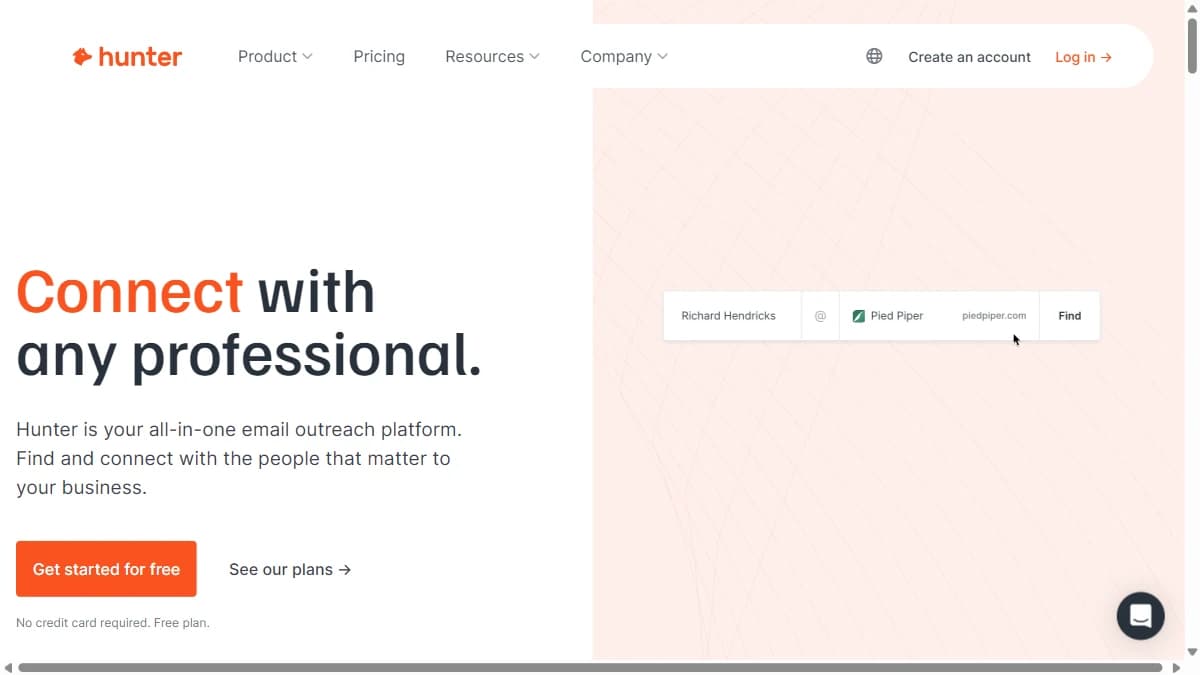
Hunter.io — simplest pure-play lead mail finder with domain search and confidence scores
Hunter.io is the longest-running lead mail finder in the category and still the cleanest UX for teams that only need an email address. Type a domain, get a list of public email addresses associated with that company along with a confidence score and the source URL where Hunter indexed it. The Chrome extension adds the same lookup on top of any company page or LinkedIn profile. Our full Hunter.io review covers every feature in detail.
The transparency is the differentiator. Hunter does not hide behind a marketing accuracy number — every result ships with a confidence score, a source URL, and a last-verified timestamp. A verifier tool runs syntax, MX, and SMTP checks on any email you paste in, and the domain search returns every indexed address on a company at once. For a solo marketer who just wants three verified emails to seed a founder-led outreach list, Hunter finishes the job in five minutes.
The limits are also honest. Hunter is not a sequencer — the built-in Campaigns feature is fine for low-volume single-mailbox sends but does not ship mailbox rotation, reply-based branching, or CRM-grade activity sync. The contact pool is narrower than Apollo because Hunter indexes the public web rather than hosting a curated 200M+ database. And credit pricing escalates once you need volume — at 5,000 searches/month, a waterfall tool like SyncGTM is usually cheaper and more accurate.
Pros
- ✓ Simplest email finder UX in the category
- ✓ Transparent confidence scores and source URLs on every result
- ✓ Free tier (50 searches/month) and low $34/month entry
- ✓ Chrome extension for LinkedIn and any company site
- ✓ Built-in verifier with syntax, MX, and SMTP checks
Cons
- ✗ Not a real sequencer — pair with Smartlead, Instantly, or SyncGTM
- ✗ Public-web indexing means narrower coverage than Apollo or ZoomInfo
- ✗ Credit pricing gets expensive past 5,000 searches/month
- ✗ One-way CRM push only — no reply or activity sync
Best for: Solo founders, agencies, and SDRs who only need verified email addresses and will send from a separate tool or mail client.
Pricing: Free (50 searches/month). Starter $34/mo. Growth $104/mo. Scale $209/mo.
Side-by-Side Comparison
| Tool | Free Tier | Paid Entry | Data Accuracy | Native Sending | Best For |
|---|---|---|---|---|---|
| SyncGTM | 100 sends/mo | $99/mo flat | Waterfall, under 3% bounce | Yes — inbox rotation + warmup | Full B2B GTM motion |
| Apollo.io | 100 credits/mo | $49/user/mo | 91% single-provider | Yes — shared sender, no rotation | Best value contact database |
| Hunter.io | 50 searches/mo | $34/mo | Confidence-scored per lookup | Light Campaigns only | Pure email lookup |
How to Choose a Lead Mail Tool
Match the tool to the motion, not to the longest feature list. Three questions cover ninety percent of the choice:
- What does "done" look like? If done is a verified email in a spreadsheet, Hunter is enough. If done is a live multichannel cadence with CRM activity sync, you need Apollo or SyncGTM. If done includes mailbox rotation, warmup, and reply-based branching at scale, only SyncGTM ships it natively.
- How deep does your data need to be? Single-provider databases (91% on Apollo, confidence-scored on Hunter) are fine for early-stage outbound. Once bounces eat your domain reputation, waterfall enrichment across 20+ sources (SyncGTM) becomes the only way to stay under 3% bounce at scale.
- What is your real budget? $0 today — Hunter (50 searches) or Apollo (100 credits). Under $50/month per seat and database-heavy — Apollo. Flat $99/month with full enrichment + outbound + CRM sync — SyncGTM replaces a $300–500/month stitched stack.
Do not buy a finder and expect a sequencer — Hunter Campaigns will frustrate you past a few hundred sends. Do not buy a database and skip warmup — Apollo's shared sender will throttle deliverability once you exceed ~200 emails/day per domain. And do not run cold outbound from a newsletter tool; see our B2B cold emailing guide for the full deliverability playbook, plus our AI sales emails guide for copy that actually replies.
Final Verdict
For B2B GTM teams evaluating lead mail tools in 2026, SyncGTM is the top pick — the only platform that bundles verified lead discovery with waterfall enrichment across 20+ providers, mailbox rotation, autoresponder sequences, and native CRM sync on every paid plan, at $99/month and no feature gates. That single tool replaces a stitched stack of Apollo + Smartlead + Clay + HubSpot Ops Hub and removes the ongoing Zap maintenance.
Apollo.io is the right pick for solo SDRs and small outbound teams who want the largest self-serve contact database and a capable built-in sequencer at $49/user/month. Pair it with a dedicated warmup tool once you push past 200 emails/day per domain. Hunter.io is the right pick for founders and agencies that only need the email address and will send from a separate tool — the confidence scores and Chrome extension make it the fastest finder on this list at $34/month.
Whichever system you pick, the rule stays the same: a lead mail tool is only as valuable as the motion it powers. The platform that wins in 2026 is the one that turns a target account into an enriched contact, a contact into a sequence, a sequence into a reply, and a reply into a CRM event — without a manual handoff. If that is what you are hiring for, start a free SyncGTM workspace and ship it by tomorrow.