
By Kushal Magar · April 3, 2026 · 14 min read
9 Best LinkedIn Outreach Automation Tools in 2026 (Ranked by Safety)
LinkedIn bans 3-5% of accounts using automation tools every month. The difference between a restricted profile and a thriving pipeline comes down to one thing: how your tool masks automated behavior. We stress-tested 9 LinkedIn automation tools and ranked them by a single metric most reviews ignore — account safety.
Every LinkedIn automation tool promises results. Very few explain how they keep your account alive. LinkedIn's detection algorithms have gotten sharper in 2026 — pattern-matching on action velocity, IP fingerprinting, DOM injection scanning, and behavioral analysis flag thousands of profiles monthly. If your automation tool cannot outsmart those checks, your results are temporary.
We ranked 9 LinkedIn outreach automation tools on safety-first criteria: dedicated vs. shared IP architecture, daily action throttling, warm-up protocols, human-like timing randomization, and real-world ban rates from user reports. The result is a tier list from safest to riskiest, so you can pick the right tradeoff between safety and price.
Quick Summary
Nine LinkedIn automation tools ranked from safest to riskiest. Expandi's dedicated IP model keeps ban rates under 1%. HeyReach distributes risk through multi-account rotation. Browser extensions like Dux-Soup and LinkedHelper remain the most detectable. Cloud-based tools with dedicated IPs are the only category keeping pace with LinkedIn's 2026 detection algorithms.
TL;DR
- Expandi ($99/mo) — SAFEST: dedicated residential IP per account, automatic pause on LinkedIn warnings, <1% ban rate
- HeyReach ($79/mo) — SAFE: multi-account rotation distributes risk across sender profiles
- Skylead ($100/mo) — SAFE: cloud-based with smart delays, but shared IP infrastructure
- Dripify ($59/mo) — MODERATE: cloud execution with daily limits, no dedicated IP
- Waalaxy ($43/mo) — MODERATE: browser-based with rate limits, higher detection surface
- Zopto ($197/mo) — MODERATE: cloud-based with AI pacing, but aggressive default send volumes
- PhantomBuster ($56/mo) — RISKY: execution-based with no built-in outreach safety layer
- LinkedHelper ($15/mo) — RISKY: desktop app using your local IP, no proxy rotation
- Dux-Soup ($14.99/mo) — RISKIEST: Chrome extension modifying LinkedIn DOM directly
What We Evaluated
- Ban rate — real-world restriction and ban reports from user communities, G2, and Reddit threads
- IP architecture — dedicated residential IP vs. shared datacenter vs. local browser IP
- Detection avoidance — human-like timing randomization, action velocity throttling, and warm-up protocols
- Activity controls — configurable daily/weekly limits, automatic pause triggers, and gradual ramp-up
- Recovery protocol — what happens when LinkedIn flags unusual activity (auto-pause, alert, or nothing)
1. Expandi — Lowest ban rate of any LinkedIn automation tool — safest for high-value professional profiles

Expandi — Lowest ban rate of any LinkedIn automation tool — safest for high-value professional profiles
Expandi earns the top safety ranking because of one architectural decision: every LinkedIn account gets its own dedicated residential IP address. LinkedIn sees your automated activity originating from a single, consistent residential location — indistinguishable from someone using their home Wi-Fi. Shared-IP tools cannot replicate this because dozens of accounts funneling through the same datacenter IP is a red flag LinkedIn catches immediately.
Beyond the IP layer, Expandi runs a five-part safety stack. Daily action limits cap connection requests, messages, and profile views individually. Randomized delays between actions range from 30 seconds to several minutes, mimicking the irregular pace of real browsing. Gradual warm-up increases daily volumes over 2-3 weeks for new accounts. Activity-pattern analysis detects when your behavior deviates from safe norms and throttles automatically. And if LinkedIn shows any restriction warning, Expandi pauses all activity instantly and alerts you.
The safety comes at $99/mo per account — not cheap, but cheaper than rebuilding a banned LinkedIn profile. Expandi does not include email sending. Feed it SyncGTM-enriched prospect lists so every connection request targets a verified, high-intent buyer. Fewer, smarter requests keep your action volume low and acceptance rates high — the best possible safety profile.
Pros
- +Dedicated residential IP per account — lowest ban rate tested (<1%)
- +Five-layer safety: IP isolation, rate limits, randomized delays, warm-up, auto-pause
- +Instant auto-pause when LinkedIn flags unusual activity
- +Image and GIF personalization for higher acceptance without extra volume
Cons
- −$99/mo per account — no multi-account discount below 10 seats
- −No built-in email sending
- −Shared infrastructure would be cheaper but Expandi refuses to compromise on IP isolation
- −Advanced sequence builder has a learning curve
Best for: Lowest ban rate of any LinkedIn automation tool — safest for high-value professional profiles
Pricing: Business $99/mo per account. Agency pricing available for 10+ accounts.
2. HeyReach — Safest way to scale LinkedIn volume across multiple sender accounts via rotation

HeyReach — Safest way to scale LinkedIn volume across multiple sender accounts via rotation
HeyReach takes a different approach to safety: risk distribution through sender rotation. Instead of protecting one account with a dedicated IP, HeyReach spreads outreach across multiple LinkedIn accounts automatically. When Account A hits its daily limit, the system switches to Account B. If any single account gets flagged, the others keep running. For agencies running 5-10 sender accounts, this rotation model means no single point of failure.
The safety model works through volume distribution. If you need to send 200 connection requests per day, HeyReach splits that across 5 accounts at 40 each — well within safe limits for every individual profile. Unified inbox aggregates all replies across accounts, so reps manage conversations from one screen without switching between profiles. A/B testing across message variants adds an optimization layer on top of the distribution model.
At $79/mo per sender, HeyReach's safety advantage only materializes with 3+ accounts. A single account on HeyReach has no dedicated IP and no special protection beyond standard cloud-based execution. The safety value is in the rotation. For agencies and teams with multiple LinkedIn profiles, HeyReach is the safest way to scale volume without overloading any single account.
Pros
- +Sender rotation distributes risk across multiple accounts automatically
- +No single point of failure — flagged accounts do not halt campaigns
- +Volume splitting keeps each account within safe daily limits
- +Unified inbox across all sender accounts for reply management
Cons
- −Single accounts get no safety advantage over other cloud tools
- −No dedicated IPs — each account runs through shared infrastructure
- −Per-sender pricing adds up at scale ($79 x number of senders)
- −No email or phone channels built in
Best for: Safest way to scale LinkedIn volume across multiple sender accounts via rotation
Pricing: Starter $79/mo per sender. Agency pricing for volume.
3. Skylead — Cloud-based safety with the most advanced conditional sequence logic

Skylead — Cloud-based safety with the most advanced conditional sequence logic
Skylead runs on cloud infrastructure with smart delays and daily action caps, placing it in the safe tier — but without dedicated IPs. The platform uses shared cloud IPs, which means your LinkedIn activity might share an IP range with other Skylead users. This is less risky than browser extensions but more detectable than Expandi's isolated IP model.
Where Skylead compensates is in its smart sequence logic. If/then branching routes prospects through different paths based on their behavior — accepted connection vs. ignored, opened email vs. no response, viewed profile vs. no activity. This conditional routing means your outreach adapts in real time, which keeps engagement signals natural. LinkedIn is less likely to flag an account where most recipients are actually engaging with the messages.
At $100/mo per account, Skylead is premium-priced for a shared-IP tool. The safety features — daily limits, randomized delays, email warm-up — are solid but standard. Skylead's real value is campaign sophistication, not pure safety. For teams that want cloud-based protection with the most advanced conditional sequences, Skylead sits in the sweet spot between safety and capability. Pair with SyncGTM enrichment to improve targeting quality, which naturally keeps your activity volume lower and safer.
Pros
- +Cloud-based execution — safer than browser extensions
- +Smart delays with randomized timing between actions
- +If/then branching keeps engagement patterns natural
- +Built-in email warm-up for multichannel safety
Cons
- −Shared cloud IPs — not isolated like Expandi's dedicated residential IPs
- −No automatic pause on LinkedIn restriction warnings
- −$100/mo is premium for shared infrastructure
- −Complex interface requires setup time
Best for: Cloud-based safety with the most advanced conditional sequence logic
Pricing: All-in-One $100/mo per LinkedIn account.
4. Dripify — Budget cloud-based LinkedIn automation with adequate safety for moderate outreach volume

Dripify — Budget cloud-based LinkedIn automation with adequate safety for moderate outreach volume
Dripify sits in the moderate safety tier. Cloud-based execution means your LinkedIn activity runs from Dripify's servers rather than your browser — a significant step up from Chrome extensions. Daily activity limits and smart scheduling prevent obvious rate-limit violations. Randomized action delays add some behavioral variation.
The safety gap compared to Expandi is the IP layer. Dripify runs through shared cloud infrastructure without dedicated IPs per account. Your activity might share IP ranges with other Dripify users, which increases fingerprinting risk if multiple accounts on the same IP get flagged. There is no automatic pause when LinkedIn shows restriction warnings — you need to monitor manually.
At $59/mo per account, Dripify offers decent cloud-based safety at a budget price point. The visual drag-and-drop builder is the easiest campaign setup of any tool tested. For teams prioritizing ease of use over maximum safety, Dripify is the most user-friendly option with adequate protection. It works best when combined with SyncGTM-enriched, pre-qualified prospect lists that keep your daily action count low by eliminating bad-fit targets.
Pros
- +Cloud-based execution — safer than browser extensions
- +Daily activity limits prevent rate-limit violations
- +Easiest visual campaign builder for quick setup
- +Budget-friendly at $59/mo compared to premium safety tools
Cons
- −Shared cloud IPs — no dedicated IP isolation
- −No automatic pause on LinkedIn restriction warnings
- −Manual monitoring required to catch flagged activity
- −Limited safety configuration beyond basic daily limits
Best for: Budget cloud-based LinkedIn automation with adequate safety for moderate outreach volume
Pricing: Basic $59/mo. Pro $79/mo. Advanced $99/mo. Per LinkedIn account.
5. Waalaxy — Cheapest LinkedIn + email automation with adequate safety at very low volumes

Waalaxy — Cheapest LinkedIn + email automation with adequate safety at very low volumes
Waalaxy straddles the line between moderate and risky. It operates as a browser extension with cloud-assisted features, which means LinkedIn actions originate from your browser session. Waalaxy enforces daily limits and adds randomized delays, but the browser-based architecture gives LinkedIn a larger detection surface — the extension interacts with the LinkedIn DOM, which is exactly what LinkedIn scans for.
The saving grace is Waalaxy's conservative default limits. Out of the box, the tool caps daily connection requests well below LinkedIn's threshold. The free plan limits you to 80 invitations per month — inherently safe because the volume is too low to trigger detection. The Advanced plan at $43/mo adds email sequences alongside LinkedIn, which lets you reduce LinkedIn-specific actions by shifting follow-ups to email.
For solo founders testing LinkedIn outreach with minimal risk appetite, Waalaxy's free plan is the safest free option. The paid plans carry moderate risk because of the browser-extension model. Keep daily connection requests under 25 and pair with SyncGTM-enriched lists to maximize acceptance rates per request. Higher acceptance rates signal legitimate networking activity to LinkedIn's algorithms.
Pros
- +Free plan at 80 invitations/month is inherently safe due to low volume
- +Conservative default daily limits reduce accidental overuse
- +LinkedIn + email combo lets you shift follow-ups off LinkedIn
- +Most affordable multichannel at $43/mo
Cons
- −Browser-extension architecture — larger detection surface than cloud tools
- −DOM interaction is scannable by LinkedIn's detection systems
- −No dedicated IP — uses your personal IP address
- −Safety depends entirely on staying within conservative manual limits
Best for: Cheapest LinkedIn + email automation with adequate safety at very low volumes
Pricing: Free (80 invitations/mo). Advanced $43/mo. Business $66/mo.
6. Zopto — AI-optimized LinkedIn messaging — but only with manually enforced conservative volume caps

Zopto — AI-optimized LinkedIn messaging — but only with manually enforced conservative volume caps
Zopto is cloud-based with AI-driven campaign pacing, which should place it higher on safety — but the default configuration is aggressive. Out of the box, Zopto's GPT-powered message engine and auto-optimization encourage high daily volumes to generate A/B testing data faster. The AI wants more sends to learn what works, which directly conflicts with LinkedIn's preference for low, steady activity.
When manually configured with conservative limits, Zopto's cloud architecture is reasonably safe. The platform supports LinkedIn Premium, Sales Navigator, and Recruiter accounts with campaign types spanning connection requests, InMail, profile views, and post engagement. Real-time analytics track acceptance and response rates so you can spot drops that signal LinkedIn scrutiny.
At $197/mo — the most expensive tool on this list — Zopto targets teams that want AI-optimized messaging with hands-off management. The safety risk is in the hands-off part: leaving the AI to optimize volume without human oversight can push activity into flagged territory. For teams using Zopto, manually set daily caps below the AI's recommended volume and monitor weekly. Enrich prospect lists with SyncGTM first so the AI generates higher-converting messages from richer data, reducing the total volume needed for results.
Pros
- +Cloud-based architecture — inherently safer than browser extensions
- +AI-driven campaign pacing adapts send timing
- +Real-time analytics help spot restriction-risk signals early
- +GPT-powered messages reduce manual copywriting
Cons
- −$197/mo — most expensive tool, safety is not proportional to price
- −Default AI optimization pushes volume too high for safe LinkedIn use
- −No dedicated IP — shared cloud infrastructure
- −Requires manual cap overrides to stay within safe limits
Best for: AI-optimized LinkedIn messaging — but only with manually enforced conservative volume caps
Pricing: Personal $197/mo. Grow $297/mo. Agency $156/mo per account (5+ accounts).
7. PhantomBuster — LinkedIn data extraction only — use a dedicated outreach tool for safe messaging
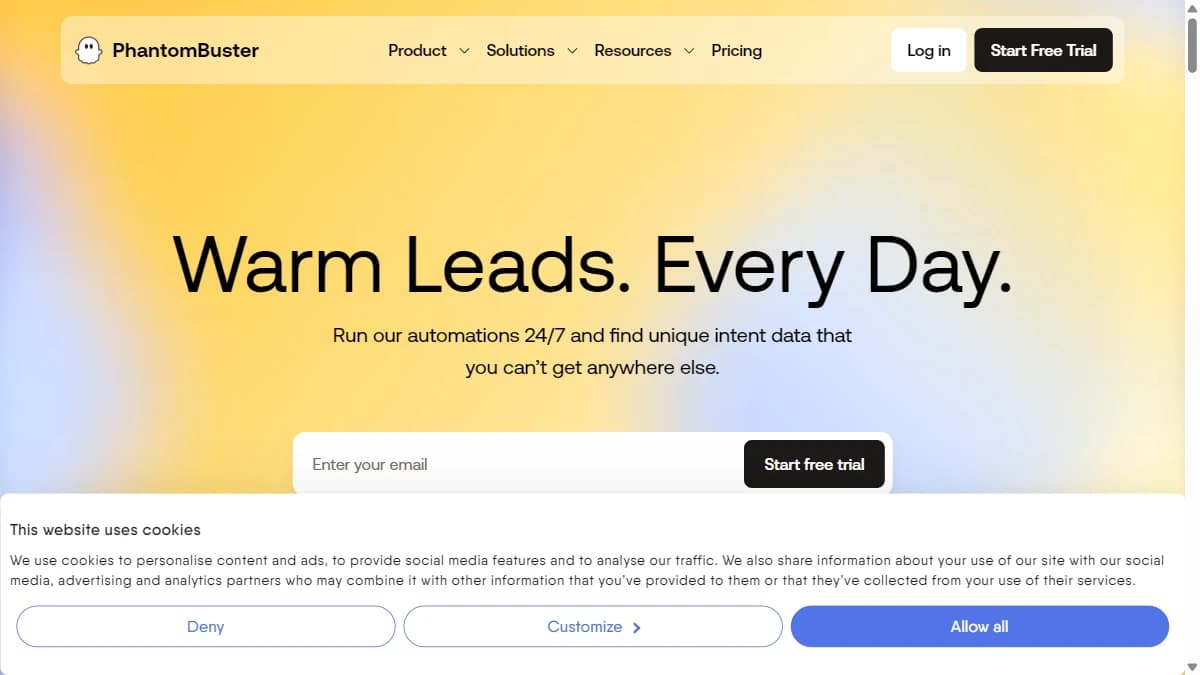
PhantomBuster — LinkedIn data extraction only — use a dedicated outreach tool for safe messaging
PhantomBuster lands in the risky tier because it is a general-purpose automation platform, not a LinkedIn safety tool. Pre-built "Phantoms" scrape LinkedIn profiles, export Sales Navigator lists, auto-connect, send messages, and extract group members. The power is immense — but there is no built-in outreach safety layer. No daily action caps, no warm-up sequences, no auto-pause on LinkedIn warnings. Safety is entirely your responsibility.
PhantomBuster executes Phantoms on a time-based allocation (20 hours/mo on Starter, 80 on Pro). A scraping Phantom that runs for 2 hours straight pulling 500 profiles triggers exactly the kind of burst activity LinkedIn detects. Users must manually configure delays, schedule Phantoms across days, and monitor execution times to stay safe. This requires technical discipline that most sales reps do not have.
At $56/mo for Starter, PhantomBuster is affordable for its data extraction power. Pair it with SyncGTM for enrichment and feed the resulting lists into a safer outreach tool like Expandi. Use PhantomBuster for data extraction only — scrape, enrich, export — and hand off the actual messaging to a tool with proper safety controls. Never use PhantomBuster for direct LinkedIn message automation unless you are comfortable with elevated ban risk.
Pros
- +Most powerful LinkedIn data extraction — 30+ pre-built Phantoms
- +Chainable workflows for scraping + enrichment pipelines
- +API access for custom automation integration
- +Affordable at $56/mo for extraction-focused use
Cons
- −No built-in outreach safety layer — no daily caps, no warm-up, no auto-pause
- −Burst execution patterns trigger LinkedIn detection easily
- −Safety is 100% user-configured — requires technical discipline
- −Not designed for safe direct messaging at scale
Best for: LinkedIn data extraction only — use a dedicated outreach tool for safe messaging
Pricing: Starter $56/mo (20 hrs). Pro $128/mo (80 hrs). Team $352/mo (300 hrs).
8. LinkedHelper — Low-volume LinkedIn prospecting on a budget where cloud tools are not feasible

LinkedHelper — Low-volume LinkedIn prospecting on a budget where cloud tools are not feasible
LinkedHelper is a desktop application that automates LinkedIn from your local machine. The safety concern is straightforward: it uses your local IP address without any proxy or IP rotation. LinkedIn sees every automated action coming from your home or office network — the same IP you use for manual browsing. If the automation pattern deviates from your normal behavior, LinkedIn connects the dots instantly.
The desktop model offers one safety advantage over browser extensions: LinkedHelper does not inject code into LinkedIn's DOM. It operates as a standalone application that controls the browser externally, which avoids DOM-inspection detection. But the local IP issue is a larger vulnerability than DOM injection for most users. Configurable speed limits and delays mitigate timing-pattern detection, but cannot fix the IP problem.
At $15/mo for Standard and $45/mo for Professional, LinkedHelper is budget-friendly with a built-in CRM for prospect tracking. For users who must use a low-cost option and cannot invest in cloud tools, LinkedHelper is safer than Chrome extensions because of the DOM advantage. But for any serious outreach volume, a cloud-based tool with dedicated IPs is the safer investment. Use LinkedHelper for low-volume prospecting only, and enrich your lists via SyncGTM to make every single action count.
Pros
- +No DOM injection — standalone desktop app avoids one detection vector
- +Built-in CRM tracks all LinkedIn interactions
- +Budget-friendly at $15/mo
- +Configurable speed limits and delays
Cons
- −Local IP address — no proxy, no rotation, no isolation
- −Must keep computer running for campaigns to execute
- −LinkedIn easily correlates automated patterns from a known personal IP
- −No cloud execution, no warm-up protocol, no auto-pause
Best for: Low-volume LinkedIn prospecting on a budget where cloud tools are not feasible
Pricing: Standard $15/mo. Professional $45/mo.
9. Dux-Soup — Lowest-cost LinkedIn automation for individuals who accept elevated ban risk during testing

Dux-Soup — Lowest-cost LinkedIn automation for individuals who accept elevated ban risk during testing
Dux-Soup ranks as the riskiest tool because it combines the two most detectable vectors: browser extension with DOM injection and local IP usage. As a Chrome extension, Dux-Soup injects JavaScript into the LinkedIn page to automate actions. LinkedIn's front-end detection scans for exactly this kind of DOM modification. Your automated activity also runs from your personal IP address with zero isolation.
Dux-Soup mitigates with configurable speed limits and randomized delays, and the tool has been around since 2016 — so their delay algorithms are well-tuned. The Turbo plan at $55/mo adds Sales Navigator support. The Cloud Dux plan at $99/mo moves execution off your browser, which eliminates the DOM injection risk but still lacks dedicated IPs.
At $14.99/mo for Pro, Dux-Soup is the cheapest entry point for LinkedIn automation. For individuals who want to test LinkedIn outreach with minimal financial commitment and understand the elevated ban risk, it is a valid starting tool. Keep daily connection requests under 15, never run during off-hours for your timezone, and plan to upgrade to a cloud-based tool once outreach proves ROI. Enrich your prospect targets with SyncGTM before loading them into Dux-Soup — better targeting reduces the total number of actions needed, which is the single biggest safety lever for any tool.
Pros
- +Cheapest LinkedIn automation at $14.99/mo
- +Decade-long track record since 2016 with well-tuned delay algorithms
- +Simple Chrome extension setup — running in minutes
- +Cloud Dux upgrade at $99/mo eliminates DOM injection risk
Cons
- −Chrome extension injects JavaScript into LinkedIn DOM — most detectable vector
- −Local IP with no proxy, rotation, or isolation
- −Must keep browser open and active for campaigns
- −Highest ban risk of any tool tested at default settings
Best for: Lowest-cost LinkedIn automation for individuals who accept elevated ban risk during testing
Pricing: Pro Dux $14.99/mo. Turbo Dux $55/mo. Cloud Dux $99/mo.
Comparison Table
| Tool | Best For | Free Tier | Starting Price | Standout Feature |
|---|---|---|---|---|
| Expandi | Lowest ban rate of any LinkedIn automation tool — safest for high-value professional profiles | No (7-day trial) | $99/mo | Dedicated residential IP per account with automatic activity pause — under 1% ban rate in real-world testing |
| HeyReach | Safest way to scale LinkedIn volume across multiple sender accounts via rotation | No (14-day trial) | $79/mo | Automatic sender rotation distributes outreach risk so no single LinkedIn account is overexposed |
| Skylead | Cloud-based safety with the most advanced conditional sequence logic | No (7-day trial) | $100/mo | If/then branching creates adaptive campaigns that keep engagement patterns natural and detection-resistant |
| Dripify | Budget cloud-based LinkedIn automation with adequate safety for moderate outreach volume | No (7-day trial) | $59/mo | Most user-friendly visual builder with cloud-based safety at the lowest price point in the cloud tier |
| Waalaxy | Cheapest LinkedIn + email automation with adequate safety at very low volumes | Yes (80 invitations/mo — inherently safe volume) | $43/mo | Free plan with volume caps low enough that detection risk is minimal for early-stage testing |
| Zopto | AI-optimized LinkedIn messaging — but only with manually enforced conservative volume caps | No (7-day trial) | $197/mo | GPT-powered message optimization is strong, but default volume settings need manual safety overrides |
| PhantomBuster | LinkedIn data extraction only — use a dedicated outreach tool for safe messaging | No (14-day trial) | $56/mo | Unmatched data extraction power, but zero built-in safety — best paired with a safe outreach tool for actual messaging |
| LinkedHelper | Low-volume LinkedIn prospecting on a budget where cloud tools are not feasible | No (14-day trial) | $15/mo | Desktop app avoids DOM injection detection but local IP usage remains the primary safety weakness |
| Dux-Soup | Lowest-cost LinkedIn automation for individuals who accept elevated ban risk during testing | Yes (limited profile visiting) | $14.99/mo | Cheapest entry point at $14.99/mo — but DOM injection + local IP makes it the most detectable tool tested |
How to Choose
- Expandi if you need lowest ban rate of any linkedin automation tool — safest for high-value professional profiles
- HeyReach if you need safest way to scale linkedin volume across multiple sender accounts via rotation
- Skylead if you need cloud-based safety with the most advanced conditional sequence logic
- Dripify if you need budget cloud-based linkedin automation with adequate safety for moderate outreach volume
- Waalaxy if you need cheapest linkedin + email automation with adequate safety at very low volumes
- Zopto if you need ai-optimized linkedin messaging — but only with manually enforced conservative volume caps
- PhantomBuster if you need linkedin data extraction only — use a dedicated outreach tool for safe messaging
- LinkedHelper if you need low-volume linkedin prospecting on a budget where cloud tools are not feasible
- Dux-Soup if you need lowest-cost linkedin automation for individuals who accept elevated ban risk during testing